A Nuclear-Weapon-Free Zone in Europe
A proposal to ban nuclear weapons of all kinds from a strip of land on both sides of the East- West boundary in central Europe is viewed as a politically feasible approach to reducing the risk of nuclear war
You are currently logged out. Please sign in to download the issue PDF.
A proposal to ban nuclear weapons of all kinds from a strip of land on both sides of the East- West boundary in central Europe is viewed as a politically feasible approach to reducing the risk of nuclear war
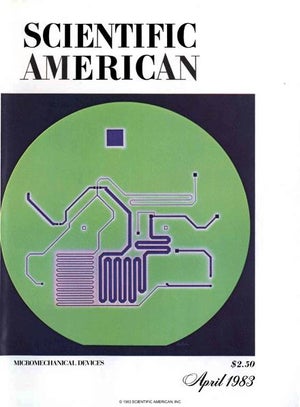
Tiny valves, nozzles, pressure sensors and other mechanical systems can be chemically etched in a wafer of single-crystal silicon. Such devices can be mass-produced much as microelectronic circuits are
They have been considered the elementary particles of matter, but instead they may consist of still smaller entities confined within a volume less than a thousandth the size of a proton
A sign of the volcanic activity that mints new oceanic crust, they nourish strange forms of life and lay down great deposits of ore. They also help to explain the chemical content of the sea
REM (rapid eye movement) sleep, the phase of sleep when vivid dreams occur, is normally accompanied by paralysis. The paralysis can now be turned off in animals, making it possible to explore the REM phase
Excavations in Poland have revealed the remains of the people who farmed, herded and hunted in the area some 7,000 years ago. It was a time of transition, but in the end agriculture had come to stay
Two cellular slime molds can coexist in the same sail and yet maintain their identity. They do so by emitting and responding to different chemicals, both of which have now been identified
Although Newton's laws are well known, tests show many people believe moving objects behave otherwise. The subjects of the tests tend to follow a theory held in the three centuries before Newton