Trauma
Accidental and intentional injuries account for more years of life lost in the Us. than cancer and heart disease. Among the prescribed remedies are improved preventive efforts, speedier surgery and further research
You are currently logged out. Please sign in to download the issue PDF.
Accidental and intentional injuries account for more years of life lost in the Us. than cancer and heart disease. Among the prescribed remedies are improved preventive efforts, speedier surgery and further research
Their promise is still not fulfilled, but now their genes have been isolated and cloned in E. coli. The bacteria are making interferon in quantity and the bacterial product is undergoing clinical trials
The dynamo mechanism for the generation of magnetic fields explains why Venus has no field, why the sun has an oscillating field and why the dominant galactic field is parallel to the plane of the galactic disk
Carbonaceous chondrites, the most primitive meteorites, incorporate material originating outside the solar system, including matter expelled by supernovas and other stars
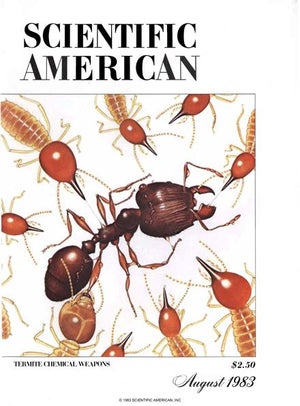
Soft-bodied and blind, termites are subject to predation. In defense termite soldiers attack intruders with an array of sophisticated irritants, toxins, anticoagulants and glues
Axiomatic analysis of voting systems has probed the compatibility of several desirable properties of an ideal method. Compromises among rationality, decisiveness and equality seem unavoidable
In the 10th century Norwegian builders blended pagan and Christian elements in wood churches. Some are stIll standing, demonstrating that with sound design and maintenance wood buildings can be permanent
Most type is now produced not by casting metal or by photography but by computer. The digital typesetter can create new letterforms with the flexibility of a scribe at up to 15,000 characters per second