The Population of China
The recent census confirms that it stands at a little more than one billion. Through strong measures to reduce the birth rate the government is seeking to have it level off at 1.2 billion
You are currently logged out. Please sign in to download the issue PDF.
The recent census confirms that it stands at a little more than one billion. Through strong measures to reduce the birth rate the government is seeking to have it level off at 1.2 billion
All higher organisms are composed of eukaryotic, or nucleated, cells. A review of the fossil record indicates that the eukaryotes originally evolved in the form of unicellular plankton some 1.4 billion years ago
Periodic variations in the geometry of the earth's orbit have long been considered a possible cause of ice ages. The idea is now supported by a more reliable chronology of glaciations
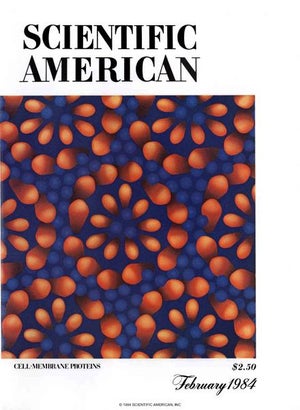
Membrane proteins are embedded in lipid, but they extend into water. The configurations that adapt them to contact with two environments are beginning to be revealed by novel electron-microscope techniques
A new technique for cooling a gas far below the normal temperature of condensation can dramatically simplify its spectrum. The result gives a highly resolved picture of complex molecular energy states
As early as the end of the fourth mlllennium B. C. proto-Sumerian and proto-Elamite scribes had well-developed systems of numbers and measures. They included precursors of our own decimal system
Most species of bees are not social like the honeybee. They are solitary, meaning that the female builds her own nest. They play a profoundly important role in pollinating crops and wild plants
How can skilled typists type as fast as they do? A century of study has not produced a definitive answer. A leading hypothesis is that a typist learning to type well learns to make mental processes overlap