Children and the Elderly in the U.S.
Since 1960. the elderly have fared far better than children at the hands of society. The reasons are related to shifts in the relative sizes of the two groups and to changes in the American family
You are currently logged out. Please sign in to download the issue PDF.
Since 1960. the elderly have fared far better than children at the hands of society. The reasons are related to shifts in the relative sizes of the two groups and to changes in the American family
Atomic systems that have decayed from some ordered states can be induced to recover their initial order. The degree to which order is restored allows investigation ofinteractions difficult to observe
Developing neurons seek one another out and interconnect with high specificity. In the insect embryo they appear to do so by following pathways whose surface is labeled by specific recognition molecules
By recording sound as a series of discrete numbers superior reproduction can be gained; so can a dramatic enhancement of recordings of performances made with other technologies
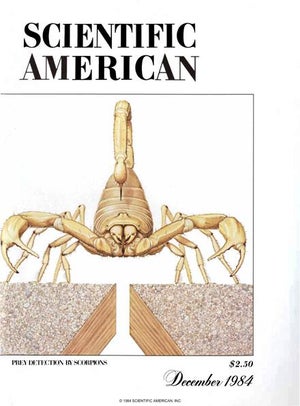
This nocturnal hunter of the Mojave Desert does not see or hear the insects it feeds on. Instead it has receptors on its legs that are extraordinarily sensitive to subtle disturbances of the sand
Now at 12,000 meters, a research well at Kola in the Soviet Arctic has revealed the cause of a seismic discontinuity and has pioneered drilling techniques for the deep exploration of the earth's crust
The imagined rotation of an object mirrors a physical rotation. The mental process can be investigated objectively, yielding quantitative information about one form of spatial thinking
Pride of place among the greatest warships of the age of sail is generally accorded to the English. Yet Spain's "Santísima Trinidad" was the largest and most formidable ship of the era