Scientific American Magazine Vol 253 Issue 3

Scientific American Magazine

Volume 253, Issue 3

You are currently logged out. Please sign in to download the issue PDF.

Features

Stopping the Production of Fissile Materials for Weapons

A halt in producing the essential ingredients of nuclear weapons would be easy to verify. It could therefore contribute to tighter control over the amount of weaponry in the superpowers' arsenals

Barbara G. Levi, David H. Albright, Frank N. von Hippel

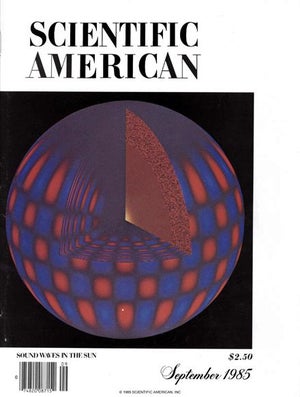
Helioseismology

Acoustic waves within the sun are visible as oscillations on the solar surface. Their pattern and period hold clues to structure, composition and dynamics in the sun's interior

John W. Leibacher, Juri Toomre, Robert W. Noyes, Roger K. Ulrich

Oligosaccharins

Fragments of the plant cell wall have been discovered that serve as regulatory molecules. They help to control such functions as growth, development, reproduction and defense against disease

Alan G. Darvill, Peter Albersheim

The Compartmental Organization of the Golgi Apparatus

This cellular organelle modifies proteins, sorts them and packages them for delivery. Recent work shows the Golgi is divided into three compartments, each specialized for a different type of modification

James E. Rothman

Bimetallic Catalysts

Chemical reaction rates are controlled by varying the composition of miniscule clusters of metal atoms. Such clusters are now employed in petroleum refining and may have a number of other applications

John H. Sinfelt

A Web-Building Jumping Spider

Unlike most other jumping spiders, the Australian species Portia fimbriata builds webs. With acute vision and deceptive predatory tactics, it hunts other spiders both in webs and on the open ground

Robert R. Jackson

Slips of the Tongue

They offer glimpses of the process underlying one of the most complex of all behaviors: speech. The study of slips is facilitated by several research techniques that induce slips in the laboratory

Michael T. Motley

Yellow Rain

A yellow substance found on rocks and leaves in Southeast Asia is alleged to be an agent of chemical war. The material is indistinguishable from the feces of indigenous honeybees

Jeanne Guillemin, Joan W. Nowicke, Matthew Meselson, Pongthep Akratanakul, Thomas D. Seeley
Departments

Letters to the Editor, September 1985

50 and 100 Years Ago: September 1985

The Authors, September 1985

Computer Recreations, September 1985

Books, September 1985

Science and the Citizen, September 1985

The Amateur Scientist, September 1985

Bibliography, September 1985