Scientific American Magazine Vol 253 Issue 5

Scientific American Magazine

Volume 253, Issue 5

You are currently logged out. Please sign in to download the issue PDF.

Features

The Treatment of Diseases and the War against Cancer

To judge the progress in the war against cancer one must understand the role of trial and error in the evolution of medicine and know something about the natural history of the commoner forms of cancer

John Cairns

Cosmic Rays from Cygnus X-3

After decades of fruitless search astronomers have found a source of high-energy particles and gamma rays bombarding the earth. The object is thought to be a binary stsr at the edge of galaxy

P. Kevin MacKeown, Trevor C. Weekes

The Calcium Signal

The calcium ion controls processes ranging from muscle contraction to cell division. An array of proteins that are specialized for binding calcium regulate its concentration in the cell and mediate its effects

Ernesto Carafoli, John T. Penniston

Terranes

They are fault-bounded blocks of crust that accrete to the ancient cores of the continents. The process makes the continents increase in extent and reworks them into what amount to geologic collages

David G. Howell

Skin Breathing in Vertebrates

It can supplement or replace breathing through lungs or gills. Special adaptations of the skin and the circulatory system help to regulate the cutaneous exchange of oxygen and carbon dioxide

Martin E. Feder, Warren W. Burggren

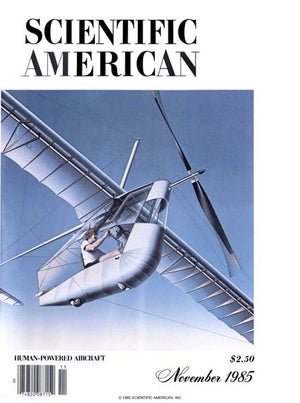
Human-Powered Flight

Human-powered aircraft exploit a little-understood Bight regime. Aircraft that can negotiate it are fun to fly and may turn out to have uses in reconnaissance and planetary science

John S. Langford, Mark Drela
Smart Cards

Cards containing microcircuitry are more versatile and securer than conventional credit cards. A microelectronic chip must meet severe constraints to function in this unique environment

Robert McIvor

Early Arctic Settlements in North America

Survival of the ances tors of the modern Eskimos and Aleuts hinged on the rela tion between culture and resources. One key to success appears to have been the capacity to exploit many sources of food

Jean S. Aigner

Departments

Letters to the Editor, November 1985

50 and 100 Years Ago: November 1985

The Authors, November 1985

Computer Recreations, November 1985

Books, November 1985

Science and the Citizen, November 1985

The Amateur Scientist

Bibliography, November 1985