Scientific American Magazine Vol 254 Issue 1

Scientific American Magazine

Volume 254, Issue 1

You are currently logged out. Please sign in to download the issue PDF.

Features

Space Science, Space Technology and the Space Station

The space-station program will seriously diminish the opportunities for advancing space science and technology if it proceeds as planned. Most national goals in space are better realized by robot spacecraft

James A. Van Allen

Growth, Differentiation and the Reversal of Malignancy

Specific proteins regulate the growth of normal white blood cells and their differentiation into nondividing forms. Leukemic cells can also be made to differentiate, suggesting new approaches to cancer treatment

Leo Sachs

The Structure of Comet Tails

The plasma tall forms and disconnects from the comet in response to the solar wind and its magnetic field. Observations of comets Giacobini-Zinner and Halley may help to clarify such phenomena

John C. Brandt, Malcolm B. Niedner

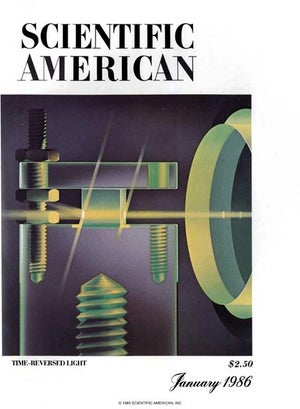
Applications of Optical Phase Conjugation

"Time-reversed" light waves can be used to improve laser-beam quality, compensate for atmospheric turbulence, track a moving satellite, encode and decode messages and compare image patterns

David M. Pepper

Mineral Deposits from Sea-Floor Hot Springs

Seawater circulating through fractured volcanic rock above sources of heat participates in chemical exchanges with the rock. A major result is significant deposits of metal, some now uplifted onto land

Peter A. Rona

The Chemical Defenses of Higher Plants

Some plant-produced chemicals poison herbivores or repel them; others reduce plants' nutritive value or impede an insect's growth. Herbivores in turn have ways of exploiting these natural products

Gerald A. Rosenthal

Radiocarbon Dating by Accelerator Mass Spectrometry

The radioactive carbon 14 is isolated from the other atoms in a sample, making it possible to derive more accurate chronologies from much smaller archaeological or anthropological specimens

John A. J. Gowlett, Robert E. M. Hedges

Kin Recognition in Tadpoles

Tadpoles of the Cascades frog prefer to associate with siblings, which they distinguish from nonsiblings. The ability to recognize kin is not based on familiarity; it may have a genetic component

Andrew R. Blaustein, Richard K. O'Hara
Departments

Letters to the Editors, 1986

50 and 100 Years Ago: January 1986

The Authors, January 1986

Computer Recreations, January 1986

Books, January 1986

Science and the Citizen, January 1986

The Amateur Scientist, January 1986

Bibliography, January 1986