The Microwave Problem
Is exposure to low levels of microwaves a hazard? How strict should exposure limits be? These issues remain in dispute in part because some findings on the biological effects of microwaves are ambiguous
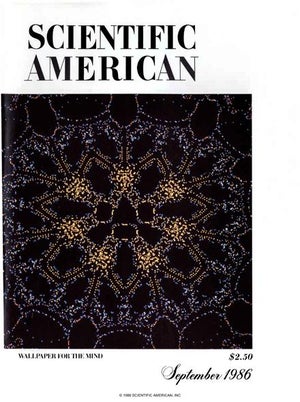
You are currently logged out. Please sign in to download the issue PDF.
Is exposure to low levels of microwaves a hazard? How strict should exposure limits be? These issues remain in dispute in part because some findings on the biological effects of microwaves are ambiguous
Methods relying on the topology of molecules-the geometric patterns in which their atoms are linked-but ignoring their three-dimensional shapes predict a broad range of properties
If all elementary particles are treated as strings, a consistent quantum theory emerges that accounts for all four fundamental forces. The theory may transform our ideas about space and time
Brain capillaries are unlike those of other organs. Their special properties enable them to serve as stringent gatekeepers between blood and brain. Recent work shows how that feat is accomplished
Color illusions devised (for the first time) on the display screen of a computer are evidence that color is not perceived just by sensing the light from individual surfaces in a scene
A cloud of interstellar gas is now streaming through the solar system. Past encounters with denser clouds may have substantially aikcted the earth's climate
There are two classes of these clam like creatures. One survives by searching out environments suited to an unchanging form, the other by adapting its form or behavior to the local environment
A close look at his visual mode of thinking, particularly in his studies of the crossbow, reveals that his ideas had a bearing on the evolution of four aspects of mechanics