Diet and Cancer
Recommendations aimed at reducing the incidence of cancers associated with nutrition are based on limited but suggestive evidence from epidemiological studies and animal experiments
You are currently logged out. Please sign in to download the issue PDF.
Recommendations aimed at reducing the incidence of cancers associated with nutrition are based on limited but suggestive evidence from epidemiological studies and animal experiments
Computer modeling suggests that they result when the denuded core of a massive star collapses. These "peculiar" supernovas are close cousins of this year's bright event
In its infancy genetic engineering was confined to the manipulation of individual genes. Now the same strategies can be used to create whole chromosomes in order to investigate chromosome behavior
A threadlike beam of electrons wiggling through a gauntlet of magnets in a storage ring produces the world's brightest ultraviolet light and X rays. Such radiation opens the way to new science and technology
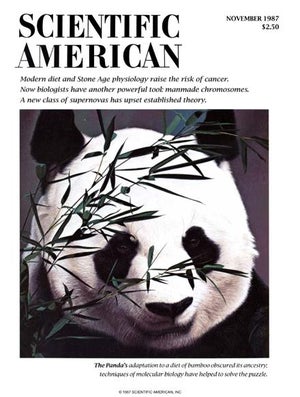
Is the panda a bear? Is it a raccoon? Or does it actually belong in a family of its own? Molecular analysis provides new insights into this long-standing genealogical problem
Since 1871 physicists have been trying to resolve the conundrum of Maxwell's demon: a creature that seems to violate the second law of thermodynamics. An answer comes from the theory of computing
Agriculture spread north and west from eastern Europe 8,000 years ago. Recent work based on distribution maps of Stone Age sites is showing how the "invasion" took place and what happened afterward
Computer simulations show that a tidal power dam in the Bay of Fundy would raise tide levels as far away as Boston. The models can now be used to help assess the environmental and economic cost of tidal power