Technology in Services
Service industries can be very technology-intensive. They can stabilize U.S. employment, make U.S. manufacturing industries more competitive and support an ever higher standard of living
You are currently logged out. Please sign in to download the issue PDF.
Service industries can be very technology-intensive. They can stabilize U.S. employment, make U.S. manufacturing industries more competitive and support an ever higher standard of living
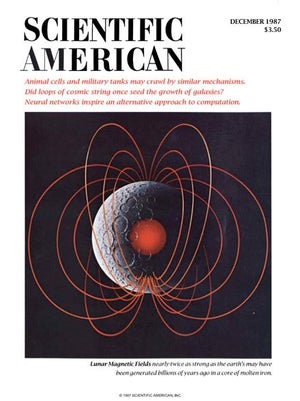
The moon is now a dead body, but it seems once to have generated its own magnetic field. Since then it has been shifted with respect to its spin axis-perhaps by collisions with moon-orbiting satellites
They do so by bringing pieces of the outer membrane into the cytoplasm and then recycling them to the surface in a directed way. Nutrients are brought into the cell by the same process
Why are stars and galaxies clumped rather than spread out evenly in space? What drew them together? Thin strings of energy created during the birth of the universe may have provided the attraction
Electronic circuits based on neurobiological models are able to solve complex problems rapidly. Their computational properties emerge {rom the collective interaction of many parts linked together in a network
An all-female species of whiptail lizards presents a unique opportunity to test hypotheses regarding the nature and the evolution of sexual behavior
Only recently have the atomic interactions underlying glass fracture been defined. The work suggests ways to slow or even stop the growth of cracks in glass and other brittle materials
Recently restored after suffering more than a century of neglect, the vessel was the first iron-hulled, armored warship. It deterred the enemy as it sealed its fate by engendering a naval arms race