Chromosome Mapping with DNA Markers
Variable sequences in the DNA of human chromosomes act as genetic landmarks. Individual markers serve for tracing defective genes; collectively the markers provide the elements of a chromosome map
You are currently logged out. Please sign in to download the issue PDF.
Variable sequences in the DNA of human chromosomes act as genetic landmarks. Individual markers serve for tracing defective genes; collectively the markers provide the elements of a chromosome map
Without a slight asymmetry in a "mirror" called CP invariance the universe as we know it would not exist; instead it would be devoid of matter. What force in nature causes the flaw?
Nerve cells not only excite their neighbors but also inhibit them. Such inhibitory activity—often mediated by an amino acid known as GABA—helps to shape the neural networks that underlie all behavior
Planets with temperate, earthlike climates were once thought to be rare in our galaxy. Mathematical models now suggest that if planets do exist outside the solar system, many of them might be habitable
The Virginia opossum can adapt quickly to a changing world. Part of its success may be due to a highly efficient reproductive strategy that includes the ability to adjust the sex ratios of its progeny
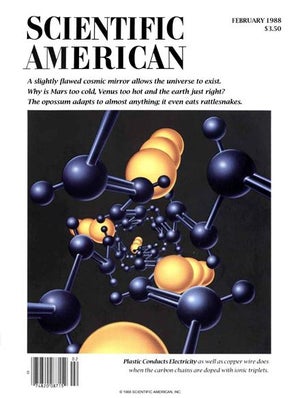
Cheap, durable, lightweight and versatile-plastics have a host of commendable properties, but conductivity is usually not counted among them. The next generation of plastics will flout tradition
Some 75 years ago an Indian mathematical genius developed ways of calculating pi with extraordinary efficiency. His approach is now incorporated in computer algorithms yielding millions of digits of pi
A bacterial disease carried by fleas that feed on rats, it has afflicted human beings for more than 1,000 years. The factors responsible for its alternate rise and fall remain a mystery