On Science Advice to the President
Right after Sputnik, the White House created the best science-advisory system in its history. The president needs good science advice more than ever; it is time to resurrect the long defunct system
You are currently logged out. Please sign in to download the issue PDF.
Right after Sputnik, the White House created the best science-advisory system in its history. The president needs good science advice more than ever; it is time to resurrect the long defunct system
Much is known about how genes are turned on and off in bacterial cells. Now molecular biologists show that what they have learned is relevant to gene regulation in higher organisms as well
They have posed a fruitful puzzle since their discovery 60 years ago. How can rock fail at the temperatures and pressures that prevail hundreds of kilometers down?
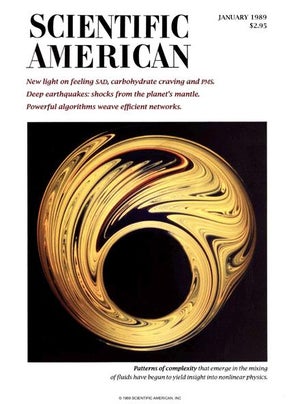
Viscous fluids flowing in simple, periodic patterns in two dimensions can generate the chaos that leads to efficient mixing. Experiments and computer models reveal the underlying mechanism
Several related behavioral disorders recognized in the past decade are characterized by disturbances of appetite and mood. One of the best-known is seasonal affective disorder, or SAD
Sixty years after its discovery, Proconsul is now known to be the last common ancestor of great apes and human beings rather than an extinct ancestor of the chimpanzee and the gorilla
What is the shortest network of line segments interconnecting an arbitrary set of, say, 100 points? The solution to this problem has eluded the fastest computers and the sharpest mathematical minds
The first investigator to quantify the magnetic effects of electric current, Ampere was also a pioneer in the philosophy of science. His philosophy shaped his method of scientific discovery