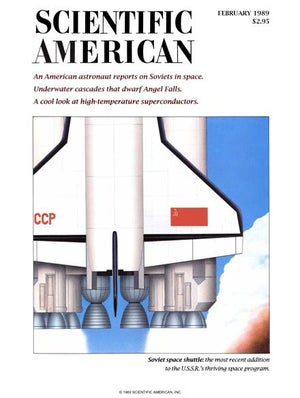
Soviets in Space
Cosmonauts have spent more than 5,600 days on board Soviet space stations since 1971. Yet cosmonaut activities are just a small part of the Soviet Union's robust space program
You are currently logged out. Please sign in to download the issue PDF.
Cosmonauts have spent more than 5,600 days on board Soviet space stations since 1971. Yet cosmonaut activities are just a small part of the Soviet Union's robust space program
Recently isolated, the genes encoding the color-detecting proteins of the human eye have yielded new clues about the evolution of normal color vision and the genetic bases of color blindness
Undersea cataracts that descend farther than any waterfall and carry more water than any river play a crucial role in maintaining the chemistry and climate of the deep ocean
Further feats of materials science are needed to realize commercial hopes for high-temperature superconductors. A long-term commitment to research will make success more likely
Studies of song-control centers in the canary brain reveal that new nerve cells are born in adulthood and that they can replace older cells. Such neurogenesis could hold the key to brain self-repair in humans
Intense ultrasonic waves traveling through liquids generate small cavities that enlarge and implode, creating tremendous heat. These extreme conditions provide an unusual chemical environment
Minute differences in tooth structure enable the author to reconstruct the great prehistoric migrations that peopled the New World as well as east Asia and the Pacific Basin
By 1880 a growing population and burgeoning data almost crippled the U.S. Census Office. Herman Hollerith came to the rescue in 1890, mechanizing the census with his punched-card tabulating system