U.S. Access to Space
For the next decade the U.S. has to rely on the shuttle and existing expendable launchers to get into space. Before launchers for the 21 st century are developed, space-program goals should be established
You are currently logged out. Please sign in to download the issue PDF.
For the next decade the U.S. has to rely on the shuttle and existing expendable launchers to get into space. Before launchers for the 21 st century are developed, space-program goals should be established
An ancient pump protein that flushes toxins out of cells may be to blame when cancer chemotherapy fails. Its identification offers hope that multidrug-resistant cancers might be made vulnerable again
Electric fields generated in plasma can propel electrons to high energies. The process promises fields 10,000 times stronger than those of the most powerful conventional accelerators
The growth of crystals is now the key to deducing the structure of large molecules.
Natural geochemical processes that result in the slow buildup of atmospheric carbon dioxide may have caused past geologic intervals of global warming through the greenhouse effect
Advances in pharmacology and in brain imaging suggest that severe obsessions and compulsions are biologically rooted. Several new drugs, first formulated as antidepressants, relieve them
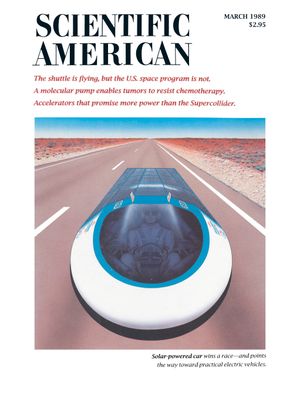
The solar car's goal was to win the World Solar Challenge race. Its longer-term benefit may be in getting people to think about practical alternatives to fuel-burning vehicles
New analyses of the once magnificent water-supply system suggest that the structural and hydraulic engineers who designed it 2,000 years ago were more sophisticated than is generally thought