Testing Weapons in Space
Would,a more permissive weapon-testing regime than is set forth in the Antiballistic-Missile Treaty be in the u.s. interest? Reviewing the rationale of the treaty's provisions helps to answer the question
You are currently logged out. Please sign in to download the issue PDF.
Would,a more permissive weapon-testing regime than is set forth in the Antiballistic-Missile Treaty be in the u.s. interest? Reviewing the rationale of the treaty's provisions helps to answer the question
Changes in the electrical and molecular properties of nerve cells accompany the learning that takes place in Pavlovian conditioning. The changes offer lessons for the design of artificial networks
Their traits arise from disorderly, discordant magnetic interactions among atoms. Mathematical models of spin glasses are prototypes for complex problems in computer science, neurology and evolution
When the earth's rigid shell is rifted, the ductile rock of the mantle wells up and partially melts. Spectacular volcanic outbursts ensue when the mantle is only slightly hotter than normal
It is the largest endocrine gland in the body, and it has a significant role in the readjustment of metabolism that accompanies pregnancy as well as fetal and infant growth
The earth's surface presents an irreproducible palette to observers in orbit. Accurate reporting of its colors can reveal new facets of both nature and human vision
After some 2.5 million years in which the archaeological record reveals very little innovation, body ornamentation and visual images explode onto the scene in Europe about 35,000 years ago
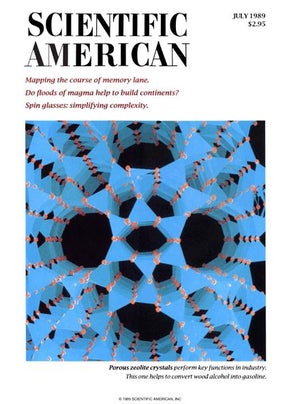
In the past 30 years man-made analogues of porous minerals called zeolites have revolutionized aspects of the petroleum industry. The search for novel commercially applicable forms continues apace