Alternatives to Animals in Toxicity Testing
The use of animals in evaluating chemical safety is costly, time-consuming and increasingly criticized by animal-welfare groups. Alternative methods can reduce the number of animals needed
You are currently logged out. Please sign in to download the issue PDF.
The use of animals in evaluating chemical safety is costly, time-consuming and increasingly criticized by animal-welfare groups. Alternative methods can reduce the number of animals needed
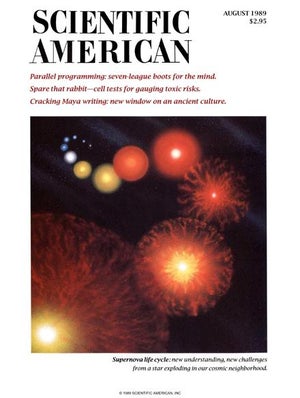
On February 23 of that year astronomers gained their first closeup view of a star's cataclysmic death since 1604. Worldwide observations have tested existing theory and added new puzzles
Certain viruses interfere subtly with a cell's ability to produce specific hormones and neurotransmitters. Persistent infections by such viruses may underlie a multitude of glandular and organic disorders
Their singing is a prelude to a fascinating array of reproductive strategies
Information refineries convert facts into knowledge. They rely increasingly on the power and elegance of parallel programming
Tiny muscles behind the eardrum contract involuntarily when a person vocalizes or is exposed to a loud noise. This neuromuscular control system prevents sensory overload and enhances sound discrimination
The Maya had the most sophisticated script in pre-Columbian America. In the past decade scholars have finally been able to read it, filling in significant gaps in our knowledge of Maya society
The controversy, which embroiled Archbishop Ussher, James Hutton, Lord Kelvin, Ernest Rutherford, Bertram Boltwood and Arthur Holmes, has "aged" the earth 4.5 billion years during the past three centuries