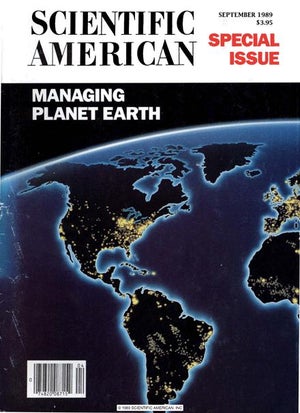
Managing Planet Earth
Introducing a single-topic issue that explores the prospects for sustainable human development on a planet with finite resources and a fragile environment
You are currently logged out. Please sign in to download the issue PDF.
Introducing a single-topic issue that explores the prospects for sustainable human development on a planet with finite resources and a fragile environment
Human activity is altering the complex mixture of gases in the atmosphere. Some effects, such as acid rain and smog, are already evident. Unwelcome surprises may be lurking
Global warming should be unmistakable within a decade or two. Prompt emission cuts could slow the buildup of heattrapping gases and limit this risky planetwide experiment
Population growth, ignorance and poverty, along with poor agricultural practices, have endangered water resources. Unless appropriate steps are taken soon, severe shortages will occur
Habitat destruction, mostly in the tropics, is driving thousands of species each year to extinction. The consequences will be dire-unless the trend is reversed
Development will stabilize populations, but will development come before population growth and harsh technologies do irremediable damage to the planet's life-support capacity?
Agricultural research will probably yield many new technologies for expanding food production while preserving land, water and genetic diversity. The real trick will be getting farmers to use them
Energy efficiency can reconcile environmental concerns with economic development for all nations. It can stretch energy supplies, slow climatic changes and buy time to develop alternative energy resources
Wastes from one industrial process can serve as the raw materials for another, thereby reducing the impact of industry on the environment
World economies are depleting stocks of ecological capital faster than the stocks can be replenished. Yet economic growth can be reconciled with the integrity of the environment
What policies can lead to the changes in behavior-of individuals, industries and governments-that will allow development and growth to take place within the limits set by ecological imperatives?