Plant Life in a CO2-Rich World
Even without considerations of global warming, increasing atmospheric levels of carbon dioxide may greatly alter the structure and function of ecosystems. These changes will not necessarily benefit plants
You are currently logged out. Please sign in to download the issue PDF.
Even without considerations of global warming, increasing atmospheric levels of carbon dioxide may greatly alter the structure and function of ecosystems. These changes will not necessarily benefit plants
Does chaos lurk in the smooth, wavelike quantum world? Recent work shows that the answer is yes-symptoms of chaos enter even into the wave patterns associated with atomic energy levels
Glucose, a crucial nutrient, must enter cells with the aid of a special transporter. Recent research elucidates the structure and function of the transporter and how insulin regulates it
Disks of matter naturally organize themselves around objects ranging from newborn stars to quasars. An unusual class of variable
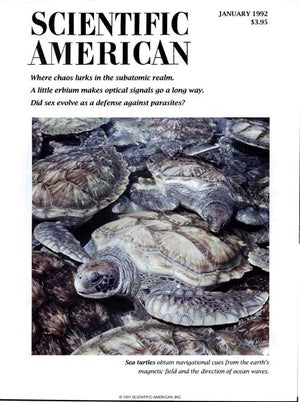
As soon as they hatch, sea turtles swim across hundreds of miles of featureless ocean; as adults, they navigate home to nest. Research has begun to identify the biological compasses and maps that guide them
Contact between Europeans and Native Americans may have shattered a delicate social balance that had existed among local tribes. One result was widespread violence
Optical fibers doped with erbium and powered by tiny laser chips are revolutionizing the way signals are regenerated for transcontinental communications and for fast data transmission over fiber-optic networks
Parasites and their hosts have devised many odd strategies-perhaps even sex-in their endless game of adaptive one-upsmanship. Yet sometimes they seem to cooperate.