Scientific American Magazine Vol 266 Issue 2

Scientific American Magazine

Volume 266, Issue 2

You are currently logged out. Please sign in to download the issue PDF.

Features

Indochinese Refugee Families and Academic Achievement

The children of Southeast Asian boat people excel in the American school system. A review of the factors underlying this achievement suggests that the U.S. educational crisis is more social than academic

Nathan Caplan, Marcella H. Choy, John K. Whitmore

Mud Volcanoes of the Marianas

Mantle rock, transformed into serpentine mud by fluids distilled from the subducting Pacific plate, oozes up along faults near the Mariana Trench to form mountains on the seafloor

Patricia Fryer

Cancer Cell Invasion and Metastasis

The most life-threatening aspect of cancer is the undetected spread of tumor cells throughout the body. Improved understanding of how these cells invade tissues is leading to new treatments

Lance A. Liotta

The Mammals of Island Europe

A mine at Messel in Germany has yielded magnificently preserved fossils of mammals that roamed Europe when it was an island. They clarify a key phase in evolutionary history

Gerhard Storch

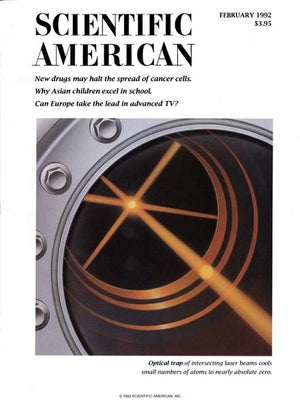
Laser Trapping of Neutral Particles

Lasers can be used to trap and manipulate electrically neutral particles. These techniques have allowed scientists to cool vapors to near absolute zero, develop new atomic clocks and stretch single molecules of DNA

Steven Chu

Turquoise in Pre-Columbian America

Before the conquistadores arrived, this gem's religious and economic significance in Mesoamerica helped to create extensive trade and cultural exchanges with the American Southwest

Garman Harbottle, Phil C. Weigand

Nikolai V. Timoféeff-Ressovsky

Controversy surrounds this Russian-born geneticist, whose major scientific achievements were made in Nazi Germany and who was later convicted of treason by the Soviet Union

Diane B. Paul, Costas B. Krimbas
Picture Perfect

Europe has bet heavily on HDTV. The outcome may presage whether 1992 will mark the emergence of a unified technological power.

Elizabeth Corcoran

Departments

Errata

Letters to the Editors, February 1992

50 and 100 Years Ago: February 1992

Early Arrivals

Night Heat

A Confusing Little Ice Age

New Whoof in Whorf

The End of Clumpiness?

Shear Bliss

Abyssal Proposal

Life in the Fast Lane

The Mephistopheles of Neurobiology

Riding on Air

A Better Red

Making Antisense

It's a Wrap

Further References

The Discreet Disappearance of the Bourgeoisie

The Kissing Number

Book Reviews, February 1992

Why Only One Big Bang?