The Developing Brain
During fetal development, the foundations of the mind are laid as billions of neurons form appropriate connections and patterns. Neural activity and stimulation are crucial in completing this process
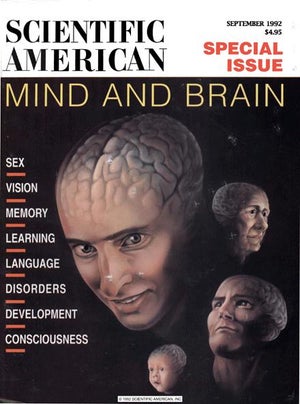
You are currently logged out. Please sign in to download the issue PDF.
During fetal development, the foundations of the mind are laid as billions of neurons form appropriate connections and patterns. Neural activity and stimulation are crucial in completing this process
In analyzing the distinct attributes of images, the brain invents a visual world. Unusual forms of blindness show what happens when specialized parts of the cortex malfunction
Recent discoveries suggest that learning engages a simple set of rules that modify the strength of connections between neurons in the brain. These changes play an important role in making each individual unique
A large set of neural structures serves to represent concepts; a smaller set forms words and sentences. Between the two lies a crudal layer of mediation
Anatomic and physiological studies of monkeys are locating the neural machinery involved in forming and updating internal representations of the outside world. Such representations form a cornerstone of the rational mind
Cognitive variations between the sexes reflect differing hormonal influences on brain development. Understanding these differences and their causes can yield insights into brain organization
Schizophrenia and manic-depressive illness are shaped by heredity and marked by structural and biochemical changes In the brain. The predisposing genes remain unknown
Late in life the human brain suffers attrition of certain neurons and undergoes chemical alterations. Yet for many people, these changes do not add up to a noticeable decline in intelligence
Networks of artificial neurons can learn to represent complicated information. Such neural networks may prOvide inSights into the learning abilities of the human brain
It can now be approached by scientific investigation of the visual system. The solution will require a close collaboration among psychologists, neuroscientists and theorists