The Aging of the Human Species
Our species has modified the evolutionary forces that have always limited life expectancy. Policymakers must consequently prepare to meet the needs of a population that will soon be much older
You are currently logged out. Please sign in to download the issue PDF.
Our species has modified the evolutionary forces that have always limited life expectancy. Policymakers must consequently prepare to meet the needs of a population that will soon be much older
Atoms and photons in small cavities behave completely unlike those in free space. Their quirks illustrate some of the principles of quantum physics and make possible the development of new sensors
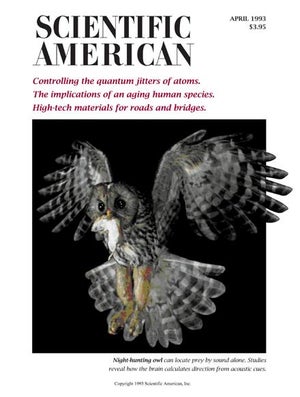
Studies of barn owls offer insight into just how the brain combines acoustic signals from two sides of the head into a single spatial perception
Scientists can now observe how solids interact with individual molecules to speed reactions. Information about these catalysts is being used to improve everything from materials synthesis to pollution control
To reproduce, this tiny fish engages in behaviors not commonly associated with such animals, including luring intruders away and cannibalizing another's eggs
Human behavior appears to influence whether pathogens evolve into benign or harmful forms. Health policy should therefore include evolutionary considerations
Modern Homo sapiens preceded Neanderthals on Mount Carmel and followed a similar pattern of life for 60,000 years. Biology thus cannot explain the cultural revolution that then ensued