The Economics of Life and Death
Mortality data can be used to analyze economic performance. Such information can illuminate critical aspects of the economic organization of society
You are currently logged out. Please sign in to download the issue PDF.
Mortality data can be used to analyze economic performance. Such information can illuminate critical aspects of the economic organization of society
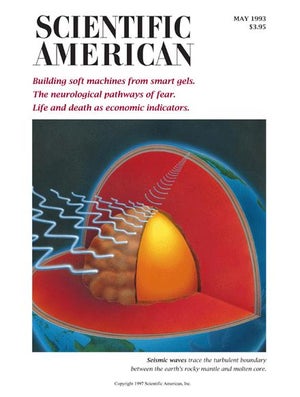
This interactive zone may be the most dynamic part of the planet, directly affecting the earth's rotation and magnetic field
During emergencies, cells produce stress proteins that repair damage. Inquiry into how they work offers promise for coping with infection, autoimmune disease and even cancer
Soft aggregations of long-chain molecules can shrink or swell in response to stimuli. They may form the basis of a new kind of machine
The authoritative appearance of modern maps belies their inherent biases. To use maps intelligently, the viewer must understand their subjective limitations
Researchers are beginning to tease apart the neurochemical processes that give rise to different fears in monkeys. The results may lead to new ways to treat anxiety in humans
He preferred the beautiful theory to the fact-buttressed ugly one because, as he noted, facts change. He proved his point by predicting the existence of antimatter
Space-based telescopes endowed with x-ray and gamma-ray vision observe an ever restless, dynamic universe.