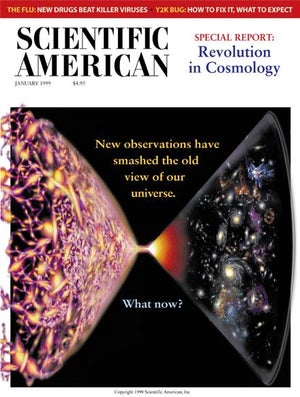
Volume 280, Issue 1
You are currently logged out. Please sign in to download the issue PDF.
Features
Surveying Space-time with Supernovae
Exploding stars seen across immense distances show that the cosmic expansion may be accelerating--a sign that the universe may be driven apart by an exotic new form of energy
Cosmological Antigravity
The long-derided cosmological constant--a contrivance of Albert Einstein's that represents a bizarre form of energy inherent in space itself--is one of two contenders for explaining changes in the expansion rate of the universe
Inflation in a Low-Density Universe
Evidence has gradually accumulated that the universe has less matter, and therefore is expanding faster, than the theory of inflation traditionally predicts. But a more sophisticated version of the theory readily explains the observations
Child Care among the Insects
Why do some insect parents risk their lives to care for their young?
Y2K: So Many Bugs... So Little Time
Fixing Y2K seems simple: change all two-digit years to four digits. But that tedious-- and unexpectedly difficult -- process takes more time than is left
DNA Microsatellites: Agents of Evolution?
Repetitive DNA sequences play a surprising role in how bacteria-- and perhaps higher organisms-- adapt to their environments. On the downside, they have also been linked to human disease
Disarming Flu Viruses
Coming soon: new medicines designed to treat the flu by halting viral replication in human tissues The drugs may also serve as a novel kind of preventive
The 1998 Nobel Prizes in Science
Here follow explanations of the mechanisms and processes that underlie the world's top awards for physics, chemistry and physiology -- and an excerpt from a Scientific American article by the economics laureate