Scientific American Magazine Vol 283 Issue 2

Scientific American Magazine

Volume 283, Issue 2

You are currently logged out. Please sign in to download the issue PDF.

Features

Fountains of Youth: Early Days in the Life of a Star

To make a star, gas and dust must fall inward. So why do astronomers see stuff streaming outward?
Thomas P. Ray

Form from Fire

Self-propagating heat waves can engender new and improved materials, but only recently have researchers found ways to monitor these ultraquick chemical reactions

Arvind Varma

The Universe's Unseen Dimensions

The visible universe could lie on a membrane floating within a higher-dimensional space. The extra dimensions would help unify the forces of nature and could contain parallel universes

Nima Arkani-Hamed, Savas Dimopoulos, Georgi Dvali

Male Sexual Circuitry

Irwin Goldstein

Birth of the Modern Diet

Ever wonder why dessert is served after dinner? The origins of modern Western cooking can be traced to ideas about diet and nutrition that arose during the 17th century

Rachel Laudan

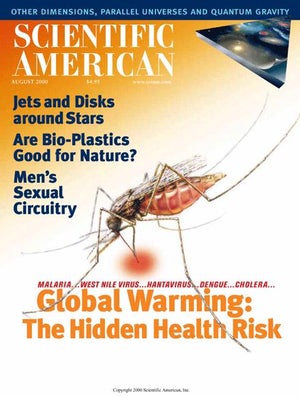
Is Global Warming Harmful to Health?

Computer models indicate that many diseases will surge as the earth¿s atmosphere heats up. Signs of the predicted troubles have begun to appear.

Paul R. Epstein

How Green are Green Plastics?

Steven C. Slater, Tillman U. Gerngross

Departments

If you can't Stand the Heat...

Erratum

50, 100 & 150 Years Ago: Zeppelin's First Flight and Observing a Firestorm

Cosmic Cartography

DNA Junk and Lupus

Size Doesn't Matter

Atomic-Force Geckos

Data Points: The Need for Zzz's

A Dose of Our Own Medicine

Sea Change for Tides

A Fractal Guide to Tic-Tac-Toe

Measure for Measure

End Point

The U.S. Population Race

The Grand Plan

Laws of Calorie Counting

Focusing in a Flash

Different Stripes

Hidden World

Blue Chip

Global Positioning

Circles of Trust

Letters

How to Rear a Plankton Menagerie

More Than the Best Medicine

Uncontrolled Burn

No Resistance

Magnetic Anomalies

Island Survivors

Gene Scenes