Whose Blood is it Anyway?
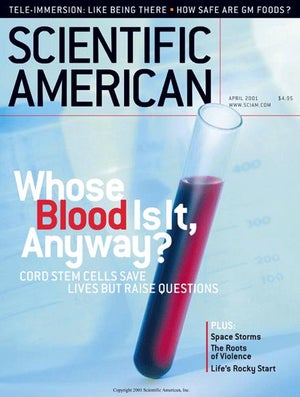
Blood collected from umbilical cords and placentas-- which are usually thrown away following birth--contains stem cells that can rebuild the blood and immune systems of people with leukemia and other cancers
You are currently logged out. Please sign in to download the issue PDF.
Blood collected from umbilical cords and placentas-- which are usually thrown away following birth--contains stem cells that can rebuild the blood and immune systems of people with leukemia and other cancers
Are genetically modified crops an environmental dream come true or a disaster in the making? Scientists are looking for answers
Two leading figures in the debate over genetic engineering defend their stances
Air, water and rock were the only raw materials available on the early earth. The first living entities must have been fabricated from these primitive resources. New experiments suggest that minerals the basic components of the rocks could have played starring roles in that dramatic feat.
Shock Waves From The Sun Can Trigger Severe Turbulence In The Space Around The Earth, Endangering Satellites And Astronauts In Orbit. Now a New Spacecraft Is Showing How Space Storms Develop
Do people turn violent because of self-hate, or self-love?
Three-dimensional tele-immersion may eventually bring the world to your desk
More than half the foods in U.S. supermarkets contain genetically modified ingredients. Have they been proved safe for human consumption?