Photonic Crystals: Semiconductors of Light
Nanostructured materials containing ordered arrays of holes could lead to an optoelectronics revolution, doing for light what silicon did for electrons
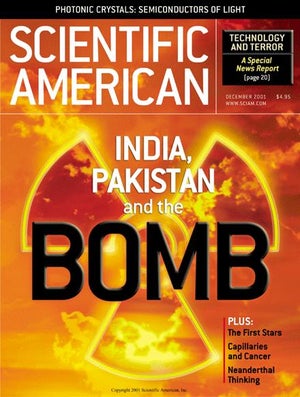
You are currently logged out. Please sign in to download the issue PDF.
Nanostructured materials containing ordered arrays of holes could lead to an optoelectronics revolution, doing for light what silicon did for electrons
The acquisition of language and the capacity for symbolic art may lie at the very heart of the extraordinary cognitive abilities that set us apart from the rest of creation
Exceptionally massive and bright, the earliest stars changed the course of cosmic history
FORGET GATES, JOBS AND WOZNIAK. THE FOUNDATIONS OF MODERN INTERACTIVE COMPUTERS WERE LAID DECADES EARLIER
The Indian subcontinent is the most likely place in the world for a nuclear war
Angiogenesis¿the formation of new blood vessels¿might one day be manipulated to treat disorders from cancer to heart disease. First-generation drugs are now in the final phase of human testing