The Cosmic Symphony
New observations of the cosmic microwave background radiation show that the early universe resounded with harmonious oscillations
You are currently logged out. Please sign in to download the issue PDF.
New observations of the cosmic microwave background radiation show that the early universe resounded with harmonious oscillations
Criminologists have not yet cracked the case, but they now know more about why U.S. crime rates plummeted in the 1990s--and how to help keep them down
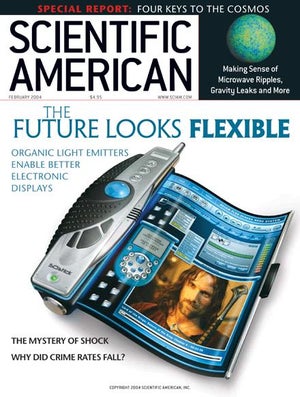
Light-emitting organic materials offer brighter and more efficient displays than LEDs. And you'll be able to unroll them across a tabletop
The big bang theory works better than ever. If only cosmologists could figure out that mysterious acceleration....
Distant supernovae are revealing the crucial time when the expansion of the universe changed from decelerating to accelerating
Still a last step before death for thousands of people, shock is shedding some of its medical mystery and becoming more treatable
The latest maps of the cosmos have surveyed hundreds of thousands of galaxies, whose clustering has grown from primordial fluctuations
Maybe cosmic acceleration isn't caused by dark energy after all but by an inexorable leakage of gravity out of our world