
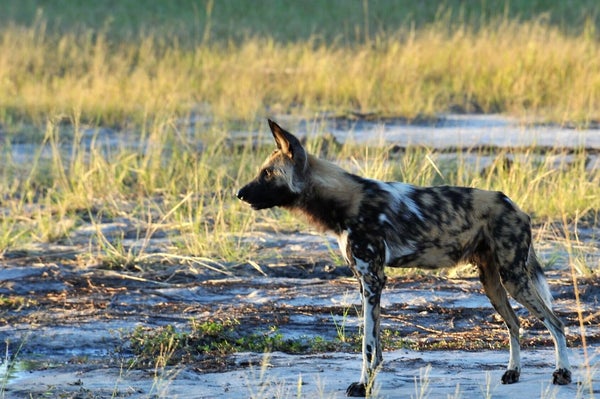

When is a sneeze more than a sneeze? For African wild dogs, it turns out that sneezes are a form of voting. Gather a bunch of wild dogs together and a sneezing chorus becomes a way of implementing democratic decision-making.
African wild dogs, also known as painted dogs thanks to their colorful, splotchy coats, are known for highly energetic greeting rituals called social rallies.
"It's kind of flat and shrubby in Botswana where these dogs are living. So they spend all day sleeping usually in the shade in dog piles without 20 meters of one another.”
On supporting science journalism
If you're enjoying this article, consider supporting our award-winning journalism by subscribing. By purchasing a subscription you are helping to ensure the future of impactful stories about the discoveries and ideas shaping our world today.
Botswana Predator Conservation Trust and Brown University researcher Hallie Walker.
“And so once one dog wants to leave and go hunting, they'll get up from rest and assume this kind of stereotyped posture…I think the easiest way to imagine it is when you get home from work and your dog is really excited to see you; they do that but with each other."
She and her colleagues noticed that dogs would sneeze a lot near the end of their social rallies. At first, they thought the dogs were simply clearing out their dusty airways, but a closer look revealed something more complex.
Walker and her team recorded the details of 68 social rallies from five different wild dog packs in Botswana. And the more sneezes they counted, the more likely it was that the pack would move off and begin hunting. One sneeze, one vote. The finding is in the Proceedings of the Royal Society B. [Reena H. Walker et al., Sneeze to leave: African wild dogs (Lycaon pictus) use variable quorum thresholds facilitated by sneezes in collective decisions]
It's not a perfectly democratic system though. When the dominant pair of dogs was involved in the sneeze-fest, the pack only required a few sneezes before they took off. But if the dominant pair was not involved, an average of 10 sneezes was needed to decide the matter. Seems that some votes carry more weight than others.
African wild dogs are highly endangered—there may be just 1,400 fully grown adults left in the wild. Walker argues that the more we can understand their behavior and pack dynamics, the better positioned we can be to protect them.
"Anything that we learn more about their decision making can help us manage them better and anticipate those decisions. So that even something as simple as understanding…how they make decisions amongst themselves will help conservationists anticipate those decisions and try to prevent any human–wildlife conflict."
—Jason G. Goldman
[The above text is a transcript of this podcast.]
[African Wild Dog sneeze audio courtesy of Reena H. Walker et al, http://rspb.royalsocietypublishing.org/content/284/1862/20170347]
