
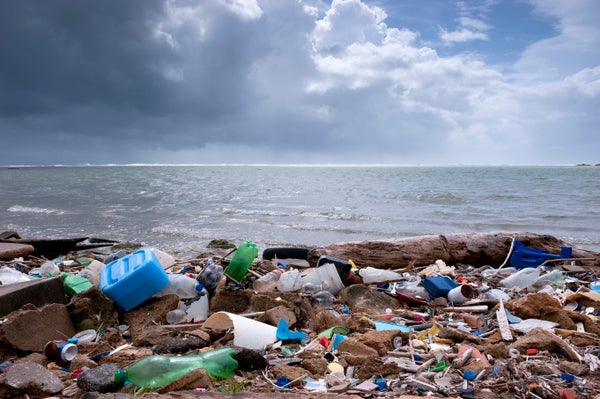

So you buy something made of plastic and it’s labeled biodegradable. You can rest easy knowing that after you throw it out it will harmlessly break down. Well, not so fast.
“When we look at biodegradability as it pertains to landfills, biodegradability is not a desirable attribute for a material. And the reason for this is that when we design for biodegradability, we’re typically designing for rapid biodegradability, and yet landfills do not begin to collect the gas that’s produced typically for two years…so much of the gas, the methane, from biodegradability is released to the environment before gas collection systems are installed.
Morton Barlaz. He heads the Department of Civil, Construction and Environmental Engineering at North Carolina State University. And he spoke June 6th on Capitol Hill at the third “Science on the Hill” event, co-hosted by Scientific American and California Congressman Jerry McNerney. The theme of this session: “Solving the Plastic Waste Problem.”
On supporting science journalism
If you're enjoying this article, consider supporting our award-winning journalism by subscribing. By purchasing a subscription you are helping to ensure the future of impactful stories about the discoveries and ideas shaping our world today.
“Now I just answered the question from a landfill perspective. If I were to switch hats and say, well, is it desirable from a litter perspective, sure. If it actually biodegrades and is converted to gas, then the litter would disappear, and that’s desirable. But let’s make sure it’s really biodegrading and not just degrading into small pieces that nobody can see. That’s degradability, it’s not biodegradability.”
Also on the panel, Kara Lavender Law, Research Professor at the Sea Education Association in Woods Hole. She studies plastic debris in the ocean. What about biodegradability there?
KL: “I do not think that it is possible to design a material that will do that in the open environment and certainly not in the ocean…my understanding is that a lot of the standards around classifying a material as biodegradable are done under temperatures of 30 C, and for reference the average temperature of the surface ocean spans 0 C to 25 C. With an average temperature of 4 C. So even if you had a magical material that satisfied all the other environmental criteria, it’s likely that that kind of breakdown would occur on such slow timescales that waste would build up and probably cause environmental harm. So…we shouldn’t think of the ocean or the environment as a magical disposal of our waste.
More of the session and a discussion of some solutions will air on an upcoming episode of the long-form Scientific American podcast, Science Talk. And the next 60-Second Science podcast will look at a new study on just how many tiny pieces of plastic you’re ingesting every day.
—Steve Mirsky
(The above text is a transcript of this podcast)

