

[CLIP: Acorn woodpeckers fight]
What you’re hearing is war—among woodpeckers, a species called acorn woodpeckers. The birds fight long, bloody battles over access to trees, where these woodpeckers nest and store their food: you guessed it, acorns.
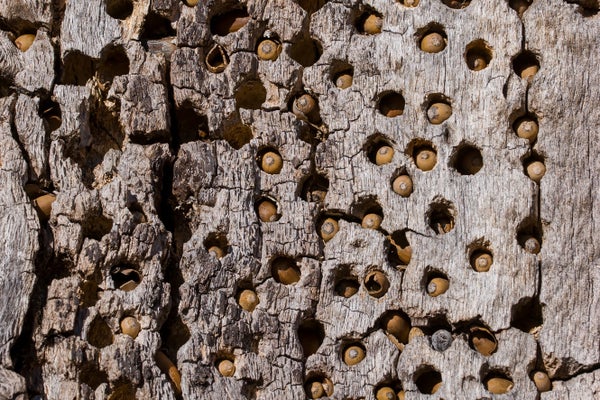
“They build these giant acorn granaries, and these are basically acorn-storage structures, where they store thousands of acorns every fall.”
On supporting science journalism
If you're enjoying this article, consider supporting our award-winning journalism by subscribing. By purchasing a subscription you are helping to ensure the future of impactful stories about the discoveries and ideas shaping our world today.
Sahas Barve, with the Smithsonian National Museum of Natural History.
“In bark and in dead parts of trees, they make individual holes in which they store one acorn at a time. And some granaries may have tens of thousands of holes.”
When woodpeckers that hold high-quality territory die, others come to claim it for themselves. That’s when the fighting begins.
“It’s a lot of energy that they put in, and that sort of tells you how valuable the granaries are for them. They put in a lot of effort in the short term for this big long-term prize.”
Barve and his colleagues tracked acorn woodpeckers during these power struggles. The researchers observed up to 12 groups of birds sparring for a single territory, typically with three or four birds per clan. Individual birds may fight more than 10 hours a day for several days.
“We didn’t know that bird conflicts could last that long; it’s really amazing. You can imagine the oak savanna of California—big oak trees. And you can just hear birds calling, because they give these very distinct ‘wacka wacka’ calls when they are fighting each other. You can hear it from far away, because there are so many birds calling, and when you go closer, you see birds flying around pretty chaotically. There are birds posturing, so most coalitions will group together, every now and then, and spread out their wings on a very prominent branch of the tree and show, basically, who they are and that they are together. But these conflicts are often very violent, so you will see birds with big injuries. So you’ll see bloodied feathers. You can see eyes gouged out, birds with some injuries that are obviously fatal. We’ve seen birds with broken wings. And also birds fall to the ground fighting each other. Like I often say, these birds have spears for mouths, so they can do a lot of damage to each other.”
Other woodpeckers flew in from up to three kilometers away just to watch the fighting—and to glean social information. The study is in the journal Current Biology. [Sahas Barve et al., Tracking the warriors and spectators of acorn woodpecker wars]
The scientists say these battles reveal a lot about animal social behavior.
“We often think of birds as not very intelligent animals, but we are discovering, very quickly, that we are not the only busybody, nosy, supercurious social animal out there. And birds are doing that all the time. Social complexity is something that’s evolved multiple times in the animal kingdom, and we are just one of them.”
—Annie Sneed
[The above text is a transcript of this podcast.]
