Air Force Tracks Final Frontier

General Jay Raymond, Commander of Air Force Space Command, talks about keeping watch over space and cyber.


Illustration of a Bohr atom model spinning around the words Science Quickly with various science and medicine related icons around the text

Join Our Community of Science Lovers!

“There’s three strategic trends that I see in space.”

General Jay Raymond, Commander of Air Force Space Command in Colorado Springs. He recently visited Scientific American to talk about Space Command, which is responsible for space and cyber for the Air Force.  

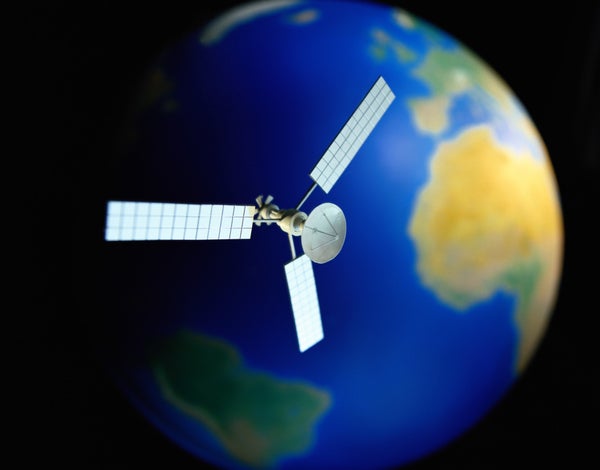
“One is space is congested…we track 23,000 objects in space. We provide the conjunction assessment warning, if you will, so for every object in space we do the analysis on every other object in space to see if there’s a potential collision. And if there’s a potential collision we make the warning for satellite operators around the world to maneuver their satellites to keep that collision from happening…


On supporting science journalism

If you're enjoying this article, consider supporting our award-winning journalism by subscribing. By purchasing a subscription you are helping to ensure the future of impactful stories about the discoveries and ideas shaping our world today.


“I see the trends of that growing. If you look at the numbers of launches that are occurring, the numbers of launches are up largely because the cost of launch has gone down. So the access to space has gotten easier…not just are the numbers of launches going up, but the numbers of satellites on each launch are also increasing…and so I see that congestion just growing in the future, and that’s something that we are obviously working to help mitigate that growing strain.

“The other thing that’s happening in space is that we are becoming more contested. I think it’s clear that space is a war-fighting domain just like air, land and sea. And we are seeing threats across the spectrum, everything from low-end reversible jamming of GPS satellites all the way up to high-end kinetic destruction, which we saw in 2007 when China shot down their weather satellite.

“And then the last thing, and I wouldn’t say it’s concerning by any means, is the increased competitive nature of space. I think that’s a good thing. I think there’s some huge opportunities here to leverage a growing commercial space market…I think as costs of launch go down and as technology allows for smaller satellites I think we’ll be able to leverage those for a wide variety of missions.”

—Steve Mirsky

[The above text is a transcript of this podcast.]

Lee Billings is a science journalist specializing in astronomy, physics, planetary science, and spaceflight and is senior desk editor for physical science at Scientific American. He is author of a critically acclaimed book, Five Billion Years of Solitude: The Search for Life Among the Stars, which in 2014 won a Science Communication Award from the American Institute of Physics. In addition to his work for Scientific American, Billings’s writing has appeared in the New York Times, the Wall Street Journal, the Boston Globe, Wired, New Scientist, Popular Science and many other publications. Billings joined Scientific American in 2014 and previously worked as a staff editor at SEED magazine. He holds a B.A. in journalism from the University of Minnesota.

More by Lee Billings

Steve Mirsky was the winner of a Twist contest in 1962, for which he received three crayons and three pieces of construction paper. It remains his most prestigious award.

More by Steve Mirsky

It’s Time to Stand Up for Science

If you enjoyed this article, I’d like to ask for your support. Scientific American has served as an advocate for science and industry for 180 years, and right now may be the most critical moment in that two-century history.

I’ve been a Scientific American subscriber since I was 12 years old, and it helped shape the way I look at the world. SciAm always educates and delights me, and inspires a sense of awe for our vast, beautiful universe. I hope it does that for you, too.

If you subscribe to Scientific American, you help ensure that our coverage is centered on meaningful research and discovery; that we have the resources to report on the decisions that threaten labs across the U.S.; and that we support both budding and working scientists at a time when the value of science itself too often goes unrecognized.

In return, you get essential news, captivating podcasts, brilliant infographics, can't-miss newsletters, must-watch videos, challenging games, and the science world's best writing and reporting. You can even gift someone a subscription.

There has never been a more important time for us to stand up and show why science matters. I hope you’ll support us in that mission.

Thank you,

David M. Ewalt, Editor in Chief, Scientific American

Subscribe