[The following is an exact transcript of this podcast.]
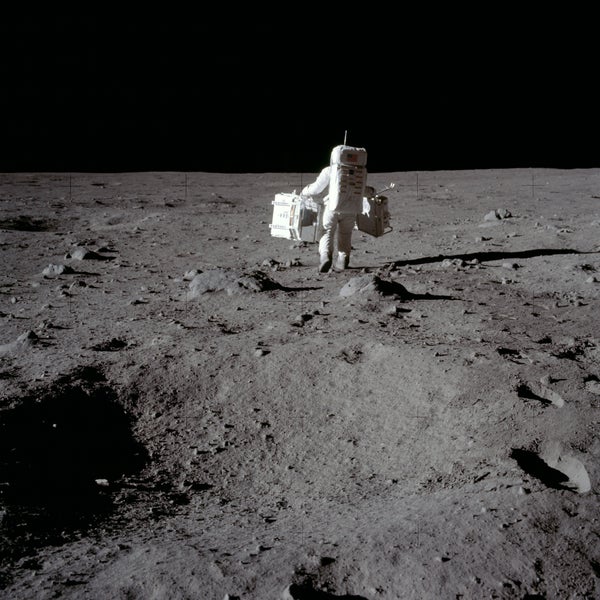
It’s the 40th anniversary of the first humans setting foot on the moon. Last August, I interviewed one of them, Buzz Aldrin, in the lobby of a hotel he was staying at in Manhattan. Near the end of our conversation I asked him to get a little existential: “What was the actual experience of being up there? Did you have any time to just say, ‘This is unbelievable?’”
Aldrin: “Well, there is no way to recreate or really anticipate the visual that we were given. You just couldn't project ahead that you are going to see unusual things like putting your foot down and the dust goes out and kind of lands in a different way. Things behave differently up there.”
On supporting science journalism
If you're enjoying this article, consider supporting our award-winning journalism by subscribing. By purchasing a subscription you are helping to ensure the future of impactful stories about the discoveries and ideas shaping our world today.
To hear the entire interview with Buzz Aldrin, just go to snipurl.com/buzzaldrin
It includes a discussion of how his doctoral thesis work at M.I.T. on guidance techniques for manned orbital rendezvous wound up coming into play during actual missions that he took part in as an astronaut.
—Steve Mirsky
Go to our In-Depth Report on the 40th anniversary of Apollo 11 landing on the moon.
Subscribe to Support Independent Journalism
Great science journalism requires human expertise, time, effort and creativity. And it costs money. That’s why I and the journalists here at Scientific American hope you’ll join our community.
When you subscribe, you are supporting staff and freelance journalists who are passionate about telling science stories that are true, important and compelling. Our editors and reporters are often experts in their fields, which means they understand the nuances of big discoveries and can untangle the breakthroughs from the hype. With a subscription, you are also supporting rigorous fact-checking to ensure the words we publish are precise and accurate. And you’re supporting original illustrations, graphics and photos that bring you closer to an advanced laboratory, an ice sheet in Antarctica or a space mission in orbit. You’re helping us craft other types of high-quality journalism as well: Our newsletters are carefully written, edited and curated by staffers you have or will come to know and love. Our Science Quickly podcast is based on original reporting, collaboration with editors and scientists and exacting production.
Subscriptions keep this engine running so we can continue to deliver thoughtful, rigorous and independent science journalism to you. In an era of viral misinformation, this work is crucial. If you value what we do, I hope you’ll consider joining us as a subscriber