
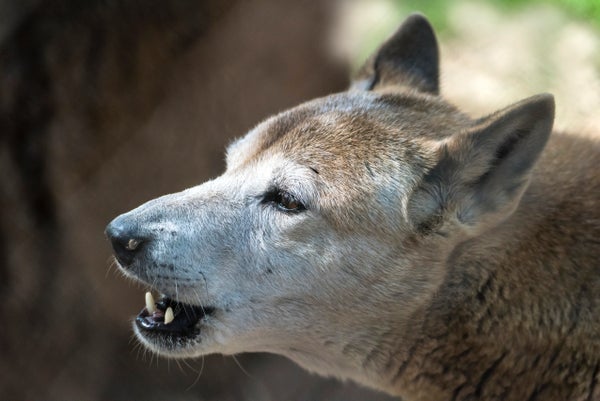

[CLIP: Barking]
Dogs were the first animals to be domesticated. And they stuck with us as we changed lifestyles from hunting/gathering to farming to city living.
“The dog is a species that is intimately linked to human history.”
On supporting science journalism
If you're enjoying this article, consider supporting our award-winning journalism by subscribing. By purchasing a subscription you are helping to ensure the future of impactful stories about the discoveries and ideas shaping our world today.
Anders Bergström, a postdoc at the Francis Crick Institute in London. He and his colleagues studied the genomes of 27 ancient dog bones dug up around the world. They found that by 11,000 years ago ...
“We see that the dog started to diversify genetically. So we find evidence of at least five major lineages of dogs already at this time.”
Dog remains have been found in Europe, Asia and the Americas in a pattern similar to how humans moved and mixed.
“To a large degree, the history of dogs seems to have been shaped by human history—so likely reflecting how, when humans moved, they would have brought their dogs with them.”
Ancient humans clearly found dogs to be very useful.
“In the Arctic, there’s evidence that sled dogs actually emerged very early, and people used them for the particular purpose of sledding, perhaps as early as 10,000 years ago.”
A few modern breeds—like the African basenji, New Guinea singing dog or Australian dingo—are similar to one of the five ancient lineages. Most other modern breeds derive at least in part from European dogs, which came to dominate dog genomes.
“If you go back 4,000 or 5,000 years ago, there’s a great diversity of dogs in Europe. But at some point, there was probably a single population that expanded and basically replaced other populations in Europe. This was something that we did not predict and you couldn’t really see just from studying archaeology. But when we look at the DNA, we see that there’s all this diversity in the past that is not represented in present-day dogs.”
The study is in the journal Science,where you’ll find maps of dog migrations over time. [Anders Bergström et al., Origins and genetic legacy of prehistoric dogs]
One odd finding: about 11,000 years ago, it looks like dogs spread more widely than humans did.
“That’s actually a process we don’t really understand. So how could the dog spread so quickly and widely? We’re not aware of any human migrations at this time that could have facilitated the spread of the dog. But somehow it spreads very quickly to human groups all across the world, perhaps because it was a very useful thing for these early human hunter-gatherer groups.”
Humans were also useful to dogs. Prehistoric Petcos didn’t exist, so dogs probably ate what humans did. And as humans started to farm, both species quickly adapted to digest more grains. The number of copies of a starch-digesting gene in both humans and dogs increased in the generations following the invention of agriculture.
“Yeah, so that’s a very striking example of convergent evolution between humans and dogs. In a way, it’s kind of interesting to think of the dog as a kind of an evolutionary experiment that runs alongside human history and undergoes the same lifestyle changes that we do.”
—Eliene Augenbraun
[The above text is a transcript of this podcast.]
