
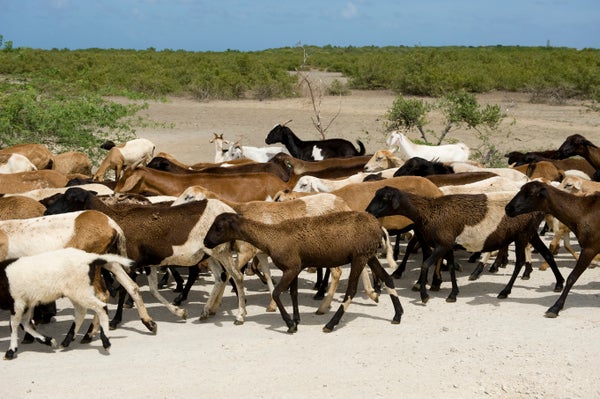

A 10,000-year-old archaeological site in central Turkey is helping scientists unlock the region’s pee-historic past. That’s right: the salty residue of ancient urine can reveal how and when humans went from hunter-gatherers to herder-farmers who kept and raised animals in their settlements.
“And so we thought, okay, what’s a process that an animal would go through if it was being kept at the site, whether it’s corralled between buildings or kept in other specific areas?”
Archaeologist Jordan Abell from Columbia’s Lamont-Doherty Earth Observatory. He’s been studying the settlement of Aşıklı Höyük, located on a 16-meter-high mound near Turkey’s Melendiz River.
On supporting science journalism
If you're enjoying this article, consider supporting our award-winning journalism by subscribing. By purchasing a subscription you are helping to ensure the future of impactful stories about the discoveries and ideas shaping our world today.
“We thought, okay, well, these animals would be urinating all the time that they were on the mound.”
In the dry climate of central Turkey, the sodium, chloride and nitrates from all that animal excretion would be trapped in the layers of earth onto which they were originally peed. Excavating those salts, layer by layer, should provide a timeline of animal populations at the site.
“And so we calculated, using a simple mass-balance approach, an estimate of the number of organisms that it would take to produce these large quantities of salt.”
Abell and his colleagues found that from 10,000 years ago to about 9,700 years ago, the site jumped from having just a few large organisms’ worth of whiz to more than 1,800.
Of course, people pee too, so the researchers had to figure out which salts were from humans and which were from their animals. Luckily, the location of the salts provided clues—for example, high concentrations in narrow alleyways too small for animals.
“The general thought is that they might have been standing on their roofs and just peeing into these alleyways.”
Something that goats and sheep do rarely, if ever. By subtracting contributions from humans, the researchers calculated that there had to be between 800 and 1,300 sheep and goats to account for the remaining pee. The study appears in the journal Science Advances. [J.T. Abell et al, Urine salts elucidate Early Neolithic animal management at Aşıklı Höyük, Turkey]
If true, it means that animal domestication didn’t originate solely in the Fertile Crescent of Mesopotamia, as many of us learned in history class.
“Our technique has been able to support that idea, that somewhere outside the Fertile Crescent, in this case in central Turkey, was developing this process at near the same time as has been shown elsewhere within the Fertile Crescent.”
An important discovery, since the advent of herding and farming was a turning point for human civilization, leading to cities and modern society.
Abell points out that many archaeological sites have little in the way of physical evidence like bones and artifacts, but presumably all of them have pee. So his advice for other archaeologists who want to track animal and human populations? Look out for number one.
—Bob Hirshon
(The above text is a transcript of this podcast)

