
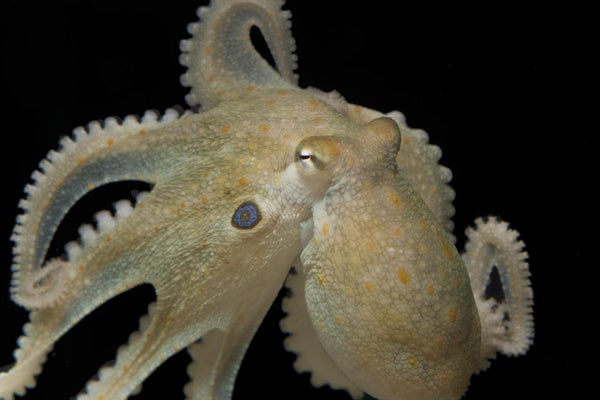

When humans take the drug MDMA—best known as ecstasy—they feel a deeper connection to others—emotionally and physically. Because MDMA affects serotonin, a nervous system chemical.
“Serotonin is one of the oldest neurotransmitters.” Gul Dolen, an assistant professor of neuroscience at Johns Hopkins University who studies social behaviors.
“It's been implicated in all kinds of functions, lots of them having nothing to do with social, and so we wanted to know, how long ago was serotonin's function really about encoding social behaviors?” So Dolen and her colleague did what any scientist would do: they gave MDMA to octopuses.
On supporting science journalism
If you're enjoying this article, consider supporting our award-winning journalism by subscribing. By purchasing a subscription you are helping to ensure the future of impactful stories about the discoveries and ideas shaping our world today.
Octopuses are asocial creatures, and their last common ancestor with us lived more than a half billion years ago. Which made them a good test subject for the question at hand.
The researchers set up a simple test: “There’s a large chamber, which is basically an aquarium tank, divided it into three chambers. On one side, we put a little overturned flowerpot that's clear and plastic and has lots of holes in it. Underneath that overturned pot, we have a toy object, and on the other side, we have another overturned orchid pot, but this one has an octopus in it.”
The researchers put an octopus in the middle chamber and watched it swim around for thirty minutes. They measured how much it interacted with on e side of the chamber—the one with the other octopus—versus the chamber with the toy. Then they soaked the test octopus in a beaker of MDMA , put it back in the aquarium and watched it for another thirty minutes. And what the researchers saw was weirdly similar to a human on MDMA:
“Before they received MDMA when they were interacting, they're very reserved, even when they're spending time in the social side, they are sort of mashing their bodies up against the side wall, and extending only one arm out to touch the flowerpot, and very tentatively touching with one arm…. After MDMA, all of the animals spent significantly more time in the side that had the other octopus in it. What's more is that the quality of their social interactions—they were much more loose in their body posturing, they were allowing several arms to touch the sides of the flowerpot, sort of hugging around the flowerpot, and exposing the bottom part of their body to the other octopus which, the way they were doing that, was suggesting they were exploring rather than any kind of aggressive posturing.”
These observations indicate that serotonin began playing a role in animals’ social behavior more than 500 million years ago.
Dolen says these findings could help scientists better understand social behavior, as well as give clues about possible treatments for serotonin-related human conditions like schizophrenia and PTSD.
Meanwhile, we’ve learned—not surprisingly, given their anatomy—that octopuses are excellent huggers.
—Annie Sneed
[The above text is a transcript of this podcast.]
[Eric Edsinger and Gül Dölen, A Conserved Role for Serotonergic Neurotransmission in Mediating Social Behavior in Octopus, in Current Biology]
