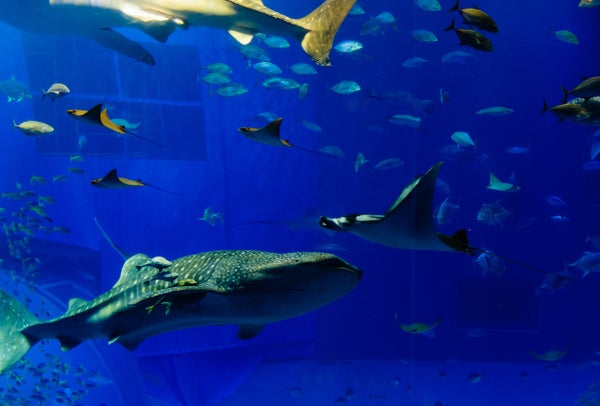

It’s called the whale shark. And, as the name implies, it’s huge. In fact, it’s the largest living fish in the world. But there’s still much unknown about this big animal.
"They’re very enigmatic in the sense that they’re elusive, very difficult to catch up with.” Alistair Dove, an expert on the biology of whale sharks and vice president of research and conservation at Georgia Aquarium.
But citizen scientists are helping Dove and other whale shark experts get a fuller picture of this marine creature. Tourists, residents and professional scientists have documented the fish for an online database, called the Wildbook for Whale Sharks. By taking advantage of each shark’s individual pattern of skin spots.
On supporting science journalism
If you're enjoying this article, consider supporting our award-winning journalism by subscribing. By purchasing a subscription you are helping to ensure the future of impactful stories about the discoveries and ideas shaping our world today.
“The Wildbook architecture was really the brainchild of Zaven Arzoumanian and Jason Holmberg…and they adapted an algorithm that was used by the Hubble telescope for recognizing patterns in star field photographs from astrophotography and realized that the spots on a whale shark are really very much the same idea. That whether we can identify individual whale sharks by their spot patterns. And with the help of whale shark scientists like Brad Normal, who is the lead author on this study, they were able to bring that into a citizen-science format that allowed people to upload photographs and use these powerful computer algorithms to recognize individual whale sharks.
“And at that point, sharks stopped being random animals that you meet in the ocean and they become individuals with stories and histories and futures that are yet to be written. And that’s what makes it so seductive as a citizen-science project.”
Whale shark watchers simply snap a photo of the skin pattern on one side of the fish—preferably the left side, says Dove. “And then you upload a picture of that animal to the Wildbook Web site, and the people on the back end will…tell you whether that animal has ever been seen anywhere before. And that’s very exciting. And it’s kind of a win-win prospect. Because if the animal’s never been seen before then you’ve added a new animal to the database and that’s exciting. If the animal has been seen before then you get to know its story and know where it’s been and when. And that’s exciting too. So it’s great fun for scientists and it’s great fun for tourists alike.”
All told, the Wildbook database now has over 5,000 citizen-science contributors, around 30,000 whale shark encounters covering 54 countries, and more than 6,000 individual whale sharks identified. In the latest study using that data, researchers report that the number of known sites where whale sharks gather has risen from 13 to 20. “By all working together and putting our data into a common pot…we get a global picture about where whale sharks are and what they’re doing.” The study is in the journal BioScience. [Bradley M. Norman et al., Undersea Constellations: The Global Biology of an Endangered Marine Megavertebrate Further Informed through Citizen Science]
The new information may lead to better conservation strategies. “The species is listed as endangered on the IUCN Red List, which means that the population is declining, and that’s cause for significant concern. So this is a species we should all be paying attention to as a bellwether of what might be expected for big animals that live in the ocean.”
—Annie Sneed
[The above text is a transcript of this podcast.]