
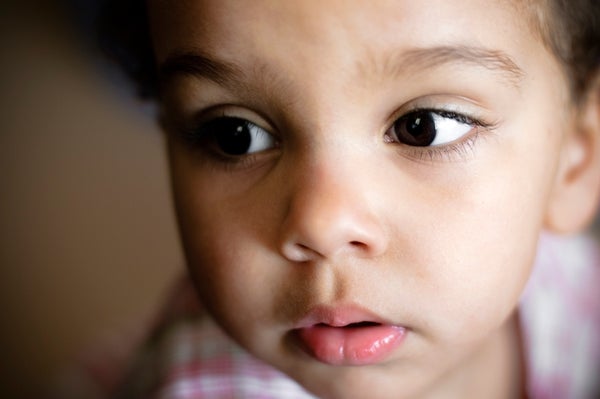

Anyone who’s ever been with a toddler can tell you: if they’re upset about something, they will let you know.
Scientists have been aware of this behavior, but what they did not know, until now, is that if babies as young as a year and a half old see someone else being treated unfairly, they expect the leader—the parent or caregiver—in that situation to step in and do something about it.
On supporting science journalism
If you're enjoying this article, consider supporting our award-winning journalism by subscribing. By purchasing a subscription you are helping to ensure the future of impactful stories about the discoveries and ideas shaping our world today.
“Babies evaluate others constantly.”
Renée Baillargeon is a psychologist at the University of Illinois. She led the research on babies expecting fairness.
“When these transgressions occur, babies evaluate parents and other leaders and say, “Well, you saw this transgression. You know this is not fair. Are you going to do something about it?” And if you don’t, then you are shirking your responsibilities, and it makes you less of a leader, less of a parent.”
That’s right, babies are judging you. Baillargeon says it seems babies are born with these expectations of what a leader is and how they should behave. The work is in the Proceedings of the National Academy of Sciences USA. [Maayan Stavans and Renée Baillargeon, Infants expect leaders to right wrongs]
The researchers used bear puppets to perform skits for 17-month-old babies, who sat comfortably on a parent’s lap.
In one scenario, the puppet leader intervenes when one of the other puppets hogs all the toys. In another, the leader does nothing to address the injustice. Baillargeon says such inaction that allows an unfair situation to persist bothers the babies, and they stare longer at that leader, as if waiting for him to act. In puppet scenarios when there was no clear leader, babies did not have this expectation of an intervention.
“It shows that they expect a leader to not just use power for his or her own self-interest but to use their authority to regulate the morality of their followers.”
Alan Fiske, an anthropology professor who studies human relationships at the University of California, Los Angeles. He was not involved in this study. He says many people underestimate what babies are capable of understanding and figuring out about the world, since they’re just barely learning how to walk and talk.
“And so you might think they don’t understand the world because, you know, they don’t seem to be very competent at doing things in the world. But ... amazing things are happening in their minds. They understand an enormous amount.”
Baillargeon says the study supports the idea that babies have an innate understanding about power dynamics that then gets shaped by the culture they grow up in.
Maybe we should lower the voting age to 17 months?
—Christine Herman
[The above text is a transcript of this podcast.]
[A version of this story originally ran on Illinois Public Media, the NPR member station serving east-central Illinois.]
