
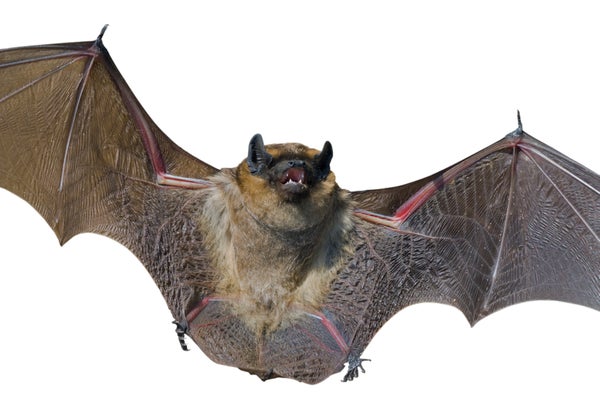

The little brown bat was once abundant in the eastern U.S. But within the last 15 years, a fungus called Pseudogynmoascus destructans infiltrated a cave in upstate New York. This fungus causes what’s called white-nose syndrome in bats.
The illness has now spread throughout North America, causing widespread bat die-offs. But recently, little brown bats in New York have stopped declining. In fact, their numbers are actually going back up.
"That was exciting, but we had no idea how these bats were persisting with the disease." Harvard University epidemiologist Kate Langwig.
On supporting science journalism
If you're enjoying this article, consider supporting our award-winning journalism by subscribing. By purchasing a subscription you are helping to ensure the future of impactful stories about the discoveries and ideas shaping our world today.
"Little brown bats, during the fall swarm around hibernacula entrances. During that time period they're active, and they're feeding and fattening for winter, they also mate during that time period. Then they go into hibernation, and that's really when infection peaks. Winter is the time period in which white nose syndrome is happening to bats."
To understand how the New York bats were surviving, Langwig and her team compared them to bats from Illinois and Virginia, in colonies that are still experiencing the initial mass die-offs. They wanted to see whether the New York bats had simply found a way to tolerate the presence of the pathogen, or whether they'd actually developed resistance to the infection.
"So we found that when bats first return to hibernacula, they still become infected. Both in areas where the fungus has recently invaded as well as in areas where the fungus is established, bats become infected at the same time. And then in both places we see the fungus begin to grow and start to increase. However in areas where the disease has been for a number of years, what we find is that the fungus then reaches kind of a plateau." [Kate E. Langwig et al.. Resistance in persisting bat populations after white-nose syndrome invasion, in Philosophical Transactions of the Royal Society B]
So in New York, the disease ramps up starting in the early winter but then the fungus stops spreading. In Illinois and Virginia, it just keeps on growing.
"It suggests that the bats are somehow actually limiting the growth of the fungus on their skin."
Langwig still doesn't know how the bats are fighting off the disease. She also wants to find out why their resistance doesn't show up until so late in the winter. Does the response wait until it hits some threshold? Do the bats' immune systems just take longer to boot up during hibernation?
And last, of course, she wants to know what lessons bat researchers can learn from this population that might help them save other types of bats in other places.
“These results, that little brown bats have developed resistance, are really encouraging to think about. We could see bats abundant once again in the Northeast.”
—Jason G. Goldman
[The above text is a transcript of this podcast.]
