

In the early 19th century the fur industry reached what was then known as the Oregon Territories. Lewis and Clark found massive numbers of Pacific salmon and steelhead trout there, swimming among the beaver dams scattered across the Columbia River Basin.
But in an effort to starve American interests, Canada’s Hudson's Bay Company tried to create a "fur desert" by killing off as many fur-bearing animals as they could. As a result, beavers had all but disappeared from the area by the year 1900. And once the beavers and their dams were gone, fish populations dropped.
Today, steelhead trout numbers in the region continue to fall. But scientists and government agencies are working to restore their habitats.
On supporting science journalism
If you're enjoying this article, consider supporting our award-winning journalism by subscribing. By purchasing a subscription you are helping to ensure the future of impactful stories about the discoveries and ideas shaping our world today.
"We're looking for restoration approaches in these areas to recover ESA-listed species, but we really don't know what works and what doesn't." Nick Bouwes of the environmental consulting firm Eco Logical Research and Utah State University.
He says that the U.S. spends a billion dollars each year to restore watersheds, but without any real empirical information to guide those efforts. So Bouwes and his team tested the idea that by helping beavers, they could help the fish.
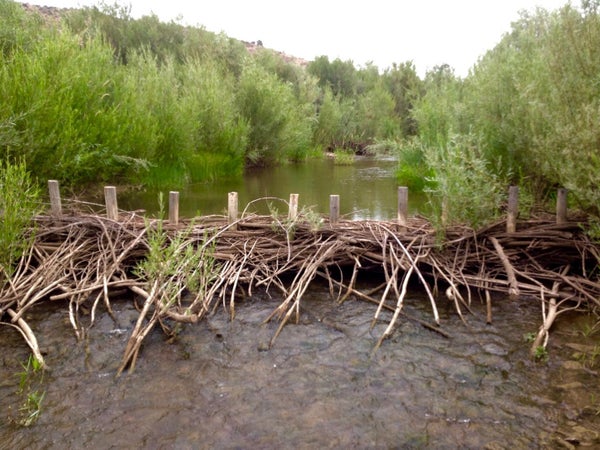
Dams naturally alter the flow of streams, providing fish with a variety of suitable habitats. But the watersheds have become so degraded that there's not enough woody vegetation available for the beavers to build strong dams. The flimsy ones they do build get washed away whenever there's a big storm.
"The idea was, can we reinforce these dams so that they maintain their integrity during high flows, and can be maintained by beavers to capture that sediment, to reconnect that floodplain?"
For seven years, the researchers compared Bridge Creek, which had lots of artificially strengthened dams, to Murderer's Creek, which had none. And in Bridge Creek, the fish flourished—despite the view held by some that beaver dams are bad for fish. The results are in the journal Scientific Reports. [Nicolaas Bouwes et al, Ecosystem experiment reveals benefits of natural and simulated beaver dams to a threatened population of steelhead (Oncorhynchus mykiss)]
"Beavers, they’re really good at making a mess of a system, and it's that messiness that's exactly what we're looking for, by creating more complex fish habitat."
And costing just $11,000 for each kilometer of stream, artificial dam reinforcements are much cheaper than conventional restoration methods—since the beavers do most of the work for us. And that is a dam good deal.
—Jason G. Goldman
[The above text is a transcript of this podcast.]
