
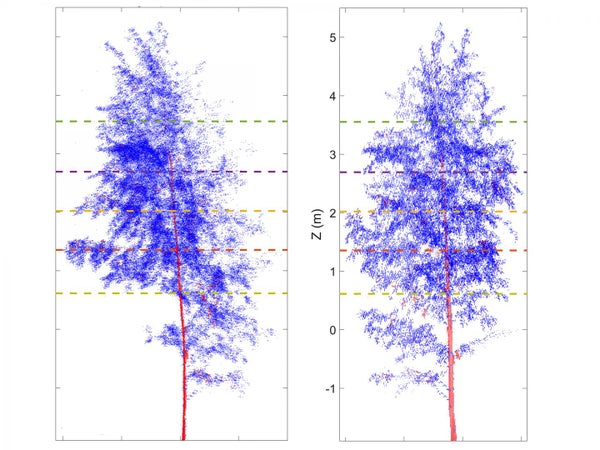

It’s easy to see that some plants change from day to night—flowers open and close, and even turn to face the sun. In 1880 Darwin noted that the leaves and seedlings of various plants appeared to engage in nighttime changes that he called sleep. But there’s now evidence that some entire trees may have their own version of sleep, which lets them recharge for the following day. That’s according to a study in the journal Frontiers in Plant Science. [Eetu Puttonen et al., Quantification of Overnight Movement of Birch (Betula pendula) Branches and Foliage with Short Interval Terrestrial Laser Scanning]
Researchers used lasers to scan birch trees in both Finland and Austria. They found that the branches drooped by as much as four inches at night compared with daytime.
And exposure to the elements was not responsible—the trees were surveyed from sunset to sunrise over enough time to rule out the changes being caused by wind or other external environmental factors.
On supporting science journalism
If you're enjoying this article, consider supporting our award-winning journalism by subscribing. By purchasing a subscription you are helping to ensure the future of impactful stories about the discoveries and ideas shaping our world today.
The researchers have a couple of ideas about what’s causing the branches to slouch. One is that the fluid pressure inside the tree decreases—something like dehydration.
The other proposal is that the trees are actually engaged in a botanical version of sleep. During the daylight hours the leaves perk upwards to get more sun, but with no chance to catch rays at night, they relax. And even before the sun rose, some branches were found to be returning to their daytime position—as the researchers say, perhaps governed by their internal circadian clock in preparation for a new day of light gathering.
But unlike us, there’s no evidence that trees sleep in on the weekend.
—Erika Beras
[The above text is a transcript of this podcast.]
