

Humans have always considered themselves special compared with other animals. One reason is the complexity of our language—bounded by unique rules, such as syntax, where we string words together in a specific order to create meaningful sentences.
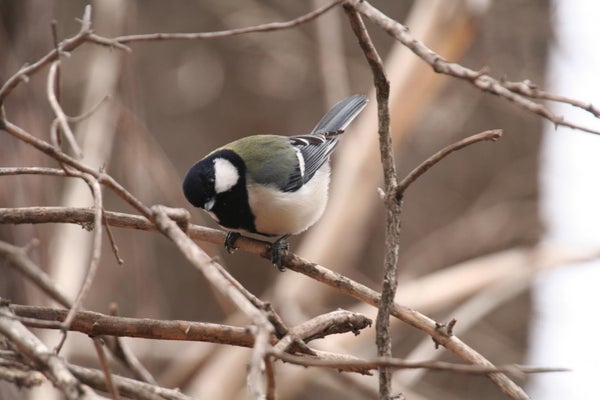
But it turns out a bird may also vocalize with syntax rules—the Japanese great tit, a bird that’s a close relative of North America’s very own chickadee. Toshitaka Suzuki, of Japan’s Graduate University for Advanced Studies, has been listening to the calls of the Japanese great tit for the past decade. Suzuki has recorded at least ten alarm calls used by the bird. These include [sound clip], known as the ABC call, which alerts other great tits to the presence of a predator, and [sound clip] the D call, which signals the birds to approach the caller.
Now Suzuki and his colleagues have found that the great tit uses those calls together to deliver both messages to other birds. And they found that the order of that call was essential—only [sound clip] ABC-D made sense to the birds. When the scientists intentionally reversed the order to create a D-ABC call [sound clip], the birds did not respond. The study is in the journal Nature Communications. [Toshitaka N. Suzuki, David Wheatcroft and Michael Griesser, Experimental evidence for compositional syntax in bird calls]
On supporting science journalism
If you're enjoying this article, consider supporting our award-winning journalism by subscribing. By purchasing a subscription you are helping to ensure the future of impactful stories about the discoveries and ideas shaping our world today.
“I think the really interesting thing is why the order matters, and figuring that out I think will be difficult but also potentially really, really interesting, because it’ll give a lot of insight...” David Wheatcroft of Sweden’s Uppsala University, one of the study scientists. “You wouldn’t expect sort of naively that it would matter. Obviously it matters in human language, the order in which we say things, but it’s still somehow shocking when you find it in tits. So I think understanding why it’s the case will be really interesting in the future.”
The work could help explain the evolution of the building blocks and structure of our own languages. [sound clip]
—Jordana Cepelewicz
[The above text is a transcript of this podcast.]
[Scientific American is part of Springer Nature.]
