
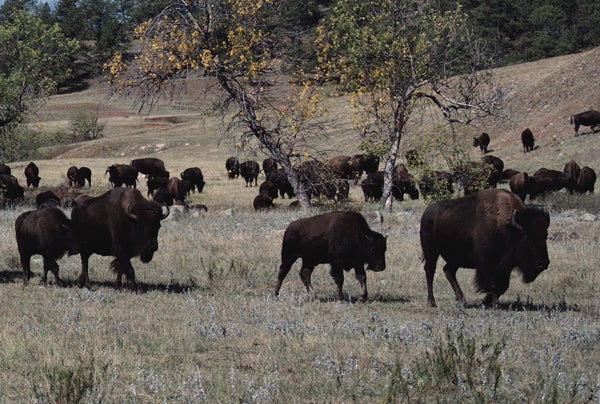

Today, November 4, is National Bison Day—celebrating the animal that last year Congress and the President designated as the official National Mammal of the United States. For good reason: the American bison, also called the buffalo, is the iconic animal that helped mold the ecology of the Great Plains and played a central role in the cultural life of multiple tribes of Native Americans, including the Arapaho and Lakota.
Today’s healthy bison herds owe a lot to time their ancestors spent in, of all places, the Bronx, in New York City.
“Well, historically the Bronx Zoo played a very important role in saving bison.”
On supporting science journalism
If you're enjoying this article, consider supporting our award-winning journalism by subscribing. By purchasing a subscription you are helping to ensure the future of impactful stories about the discoveries and ideas shaping our world today.
Patrick Thomas, Vice President of the Wildlife Conservation Society and Associate Director of its Bronx Zoo.
“In the early 1900s when bison numbers were at their lowest and the species was facing extinction, the Bronx Zoo acquired as many bison as they could, bred them and then sent offspring from that breeding herd out west to re-establish herds in the wild.”
Thomas is involved in efforts with the zoo’s current herd of bison.
“Right now we’re working to establish a herd of genetically pure bison at the zoo. Today there are about 500,000 bison in the U.S., but there’s only about between 5- and 6,000 that are genetically pure bison. The rest have small trace amounts of domestic cow genes in them. So we’re establishing a herd of pure bison, breeding them, and again our goal is to take offspring from those pure bison and establish pure bison herds out west.”
In what would be a continuation of one of the earliest success stories in American conservation.
—Steve Mirsky
[The above text is a transcript of this podcast.]
