
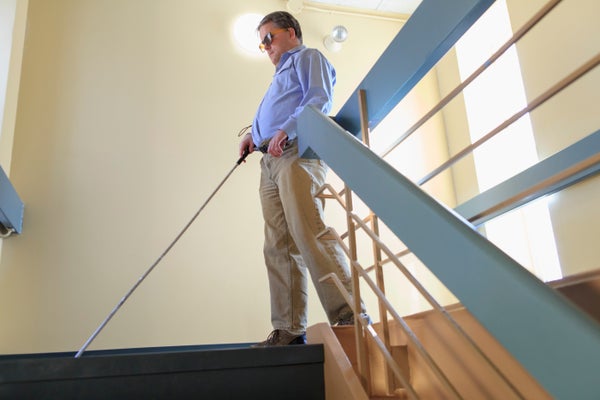

The human brain is remarkably adaptable, constantly being shaped by life experience. A striking example is that in blind people, the brain’s visual cortex is repurposed for auditory tasks—such as detecting motion and pinpointing where a sound is coming from. But its adopted functions could be even more complex.
“And the question is, well: How much can this part of the brain change its function in people who were born blind?”
Johns Hopkins cognitive neuroscientist Marina Bedny. She and her team had blind and sighted volunteers listen to audio clips from entertaining movies while undergoing functional MRI scans of their brains. The goal was to find out if, among blind people, the visual cortex is activated consistently for complex auditory tasks.
On supporting science journalism
If you're enjoying this article, consider supporting our award-winning journalism by subscribing. By purchasing a subscription you are helping to ensure the future of impactful stories about the discoveries and ideas shaping our world today.
“So we take brain activity in one person, and we correlate it to brain activity in another person. It gives you a way to directly compare how similar the processing of two brains is when they’re listening to a given stimulus. And so that can tell us, for example, whether the visual cortices of different blind people are doing the same thing at the same time.”
The result?
“You get massive synchrony over something like 65 percent of the occipital lobe, which is a lot of cortical territory.”
In other words, in blind participants, most areas of the visual cortex were activated at the same time by the movie audio.
But the visual cortices of sighted people didn’t show consistent activation. What’s more, the similarities became much less pronounced among the blind participants when the movie clips were scrambled and became meaningless. That finding suggests the visual cortex isn’t just acting like a simple sound processor.
“And that’s important because it means that this brain region likely went from being a low-level sensory area to behaving like a higher cognitive area, which suggests a very extreme level of reorganization and plasticity.”
The study appears in the Journal of Neuroscience. [Rita Loiotile et al., Naturalistic auditory stories synchronize “visual” cortices across congenitally blind but not sighted individuals]
Further research will investigate other ways in which life experiences may profoundly shape cognitive function, from reading braille to programming computers.
—Susanne Bard
[The above text is a transcript of this podcast.]
