
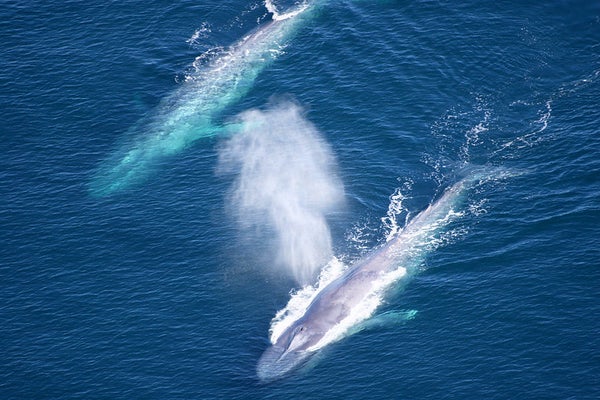

During the summer, blue whales in the Northeastern Pacific spend their days feeding on massive amounts of tiny plankton called krill. In fact, krill is all they eat.
“It really is remarkable that such a small animal is able to sustain the largest life form that’s ever existed on this planet.”
Stanford University marine ecologist Will Oestreich.
On supporting science journalism
If you're enjoying this article, consider supporting our award-winning journalism by subscribing. By purchasing a subscription you are helping to ensure the future of impactful stories about the discoveries and ideas shaping our world today.
“And to maintain themselves at that body size, they have pretty extreme feeding habits.”
A blue whale consumes many tons of krill every day. Eating keeps the ocean giants occupied during daylight hours, when they dive hundreds of feet below the surface, where krill congregate in dense swarms. But at night, when their prey disperse, the whales start to sing.
“And they’ll sing for 10, 12 hours straight.”
The song you just heard was sped up 10 times.
“Which brings the sound up more into human hearing range.”
Speeding up the song enables researchers to more easily study whales’ deep and resonant songs, which can be heard by other whales across vast distances in the ocean.
“It’s very likely that song in blue whales is related to some sort of reproductive function, whether that’s attracting a mate or warding off other males.”
Since 2015, the Monterey Bay Aquarium Research Institute has been recording the songs of blue whales with an underwater microphone attached to the seafloor.
“24/7, 365 days a year, giving an audio feed of all of the sounds being produced in and around Monterey Bay.”
When Oestreich and his team analyzed the blue whales’ singing behavior across seasons, they noticed an unusual pattern. As summer gave way to fall and winter, the whales changed when they sang.
“There was more song during the daytime than during the nighttime.”
To learn more, the scientists tagged individual whales to keep tabs on both their feeding and singing behavior. As summer krill concentrations wane, the whales begin a long southward migration to their breeding grounds off the coast of Mexico and Central America.
“Once they start migrating, feeding at depth isn’t really a part of the equation anymore. So they switch their primary time of song production to the daytime.”
Knowing when to leave is crucial.
“It’s really critical that the timing of this transition from feeding to migration be synched with other things happening in their habitats.”
The researchers think the seasonal change in singing patterns signals the start of migration, which means ...
“We’re now able to determine when the population has switched from feeding to migration.”
The study is in the journal Current Biology. [William K. Oestreich et al., Animal-borne metrics enable acoustic detection of blue whale migration]. The blue whale song recording is courtesy of John Ryan and the Monterey Bay Aquarium Research Institute.
Blue whales are endangered, but being able to monitor what they’re up to in real time could be a boon to conservation efforts—if we’re willing to listen.
—Susanne Bard
[The above text is a transcript of this podcast.]

