
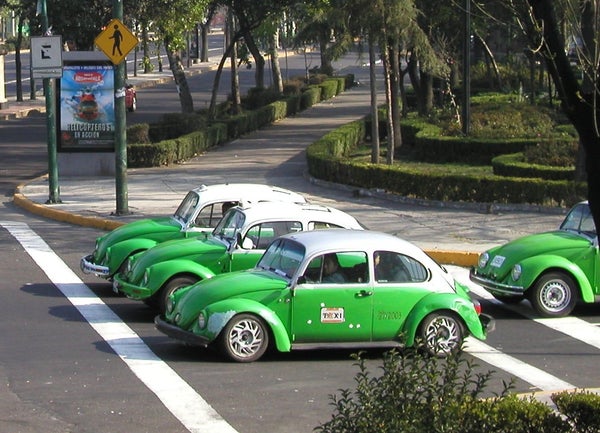

From the backseat of a cab, the moves a driver makes may at times seem, let’s say, daring. In fact, cabbies may actually be better, more agile drivers than the rest of us. Because they know their streets so well.
Previous research found that the hippocampus in the brain of a typical cab driver is enlarged. That’s the part of the brain used in navigation. But now a study confirms that learning detailed navigation information does indeed cause that part of the brain to grow. The findings are in the journal NeuroImage. [Timothy A. Keller and Marcel Adam Just, Structural and functional neuroplasticity in human learning of spatial routes]
Researchers had young adults who were not regular gamers play a driving simulation game. Some practiced maneuvering the same route 20 times, while other players were confronted with 20 different routes. The participants’ brains were scanned before they performed the simulated driving and again after.
On supporting science journalism
If you're enjoying this article, consider supporting our award-winning journalism by subscribing. By purchasing a subscription you are helping to ensure the future of impactful stories about the discoveries and ideas shaping our world today.
Researchers found that subjects who kept repeating the same route increased their speed more than those driving multiple routes. The single-route drivers were also much better able to put in order a sequence of random pictures taken along the way and to draw a map of the route.
The investigators also found increases in the single-route drivers in the functional connectivity between the hippocampus and other parts of the brain involved with navigation. And the amount of change was directly related to the amount of improvement each participant displayed.
These findings may explain why your Uber driver can eventually get you from point A to point B, but may lack the seemingly effortless mental flexibility that a yellow cabbie displays on the streets. Veterans have been there, done that—and their brains show it.
—Erika Beras
[The above text is a transcript of this podcast.]
