

Bricks are one of the oldest known building materials, dating back thousands of years.
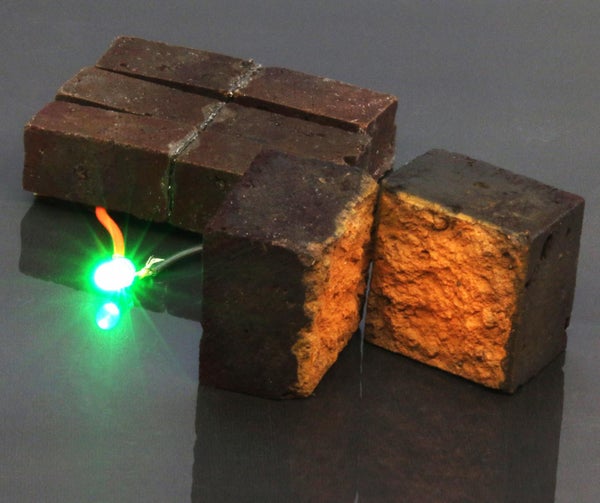
But researchers at Washington University in St. Louis have found a new use for bricks: as energy storage units. A team of engineers and chemists have found a way to transform an ordinary house brick into a pseudo-battery—allowing it to conduct and store electricity.
The bricks are powerful enough to illuminate an LED light bulb and cost only about $3 to make.
On supporting science journalism
If you're enjoying this article, consider supporting our award-winning journalism by subscribing. By purchasing a subscription you are helping to ensure the future of impactful stories about the discoveries and ideas shaping our world today.
“I love the idea of adding value to things that are inexpensive, things that are affordable, things that we kind of take for granted.”
Julio D’Arcy is an assistant professor of chemistry at Washington University and one of the researchers on this project.
The brick battery relies on the reddish pigment known as iron oxide, or rust, that gives red bricks their color. The scientists pumped the bricks with several gases that react with iron oxide to produce a network of plastic fibers. These microscopic fibers coat the empty spaces inside the bricks—and conduct electricity.
“What we’re trying to do is: we’re trying to make specialized plastics that are only used on the nanoscale—where we use very little of the plastic, and we can actually embed that plastic inside construction materials”)
The study is in the journal Nature Communications. [Hongmin Wang et al., Energy storing bricks for stationary PEDOT supercapacitors]
In the future, D’Arcy says, a brick wall could potentially serve a dual purpose: providing structural support and storing electricity generated from renewable energy sources, such as solar panels.
The technology is still at least a few years away from being ready for the commercial market. And right now the energy storage capacity of the bricks is still pretty low—about 1 percent of a lithium ion battery. But the team is now testing ways to improve brick performance—because it looks like you can teach an old brick new tricks.
—Shahla Farzan
[The above text is a transcript of this podcast.]
