
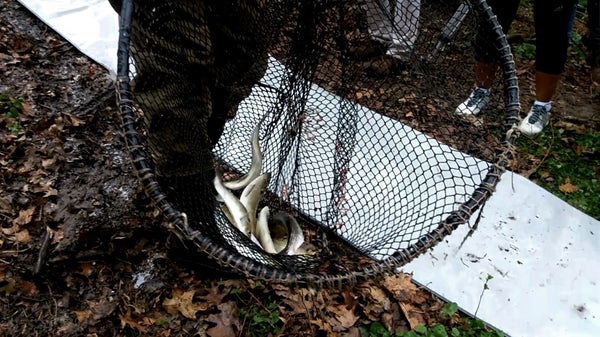

“So here’s the first of the alewives, all silvery, they’re all about the same size, you can’t tell the boys from the girls. These will be the first.”
Stephen Gephard, fisheries biologist with the Connecticut Department of Energy and Environmental Protection.
Gephard brought 400 alewives down from the Nutmeg state to be released into the Bronx River on the grounds of the Bronx Zoo on April 20th. The Bronx River was once so polluted that it was called an open sewer. But it’s been cleaned up to the point where it can now once again support these fish, which were common here in the 19th century.
On supporting science journalism
If you're enjoying this article, consider supporting our award-winning journalism by subscribing. By purchasing a subscription you are helping to ensure the future of impactful stories about the discoveries and ideas shaping our world today.
“Alewives are herring, they’re kind of like a miniature shad.” John Waldman is an aquatic conservation biologist at Queens College, who was on hand for the release.
“They’re born in fresh water, they rear for the first year in freshwater then go to sea, spend a few years growing larger and then return to the river they were born in, much like salmon or sturgeon or shad. It’s called an anadromous life history. And this river appears to have a small relic run that never really expanded because it was limited by the habitat.
“And now there’s a fish ladder on the first dam and these fish that are being stocked today, 400 alewives…and the idea here is that if they spawn in this section, the young will kind of imprint on this area, run downstream and then return when they’re old to spawn several years from now and want to go over the fish ladder.
“In the meantime, several fish have used the fish ladder on their own this week that were from wild fish that were existing as a little relic stock, I believe, in this section of the river, so between the two I think the future looks very promising to have a much larger run.
“The water here behind the Bronx Zoo is just perfect for alewife spawning, it’s very slow moving, it’s just what they like. And there’s a series of dams above this first dam that are probably going to have fish ladders in the future, too. And if we get them all online working, this little river that flows through the heart of the Bronx could become a major alewife producer, which is kind of fun in its own right, to have such an urban location producing these wild fish, but it also is a great tie to the ocean.
“Alewives and other bait fish really drive the marine food chain, and this is a contribution to our greater coastal waters. So I’m very excited by the prospects of this restoration.”
Gephard: “Alright, we gotta get ‘em in the water.”
—Steve Mirsky
[The above text is a transcript of this podcast.]
