
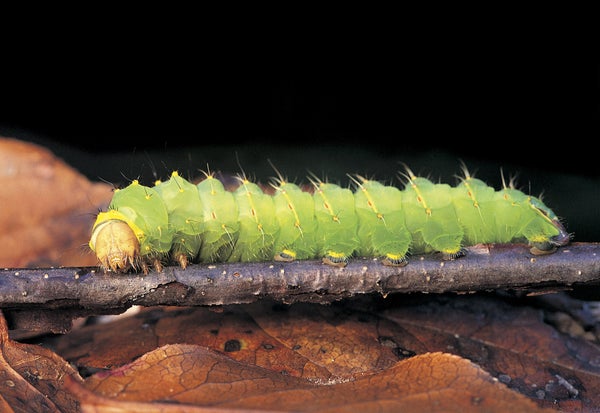

Ben Van Allen collects caterpillars. While doing postdoctoral research at Louisiana State University, Van Allen saw that some of the caterpillars were having others for lunch. Rather than cry over his losses, Van Allen took advantage of the cannibalism for his research.
“Generally speaking, it’s nutritious to eat the same species, because they have all the nutrients that are already inside you, so it’s an easy-to-process meal.”
“It also reduces the amount of competition you are going to experience – it’s just one fewer individual trying to eat the same food you are, in the same area. And it’s usually easy to find members of the same species too, since they live in the same place you do.”
On supporting science journalism
If you're enjoying this article, consider supporting our award-winning journalism by subscribing. By purchasing a subscription you are helping to ensure the future of impactful stories about the discoveries and ideas shaping our world today.
Van Allen and colleagues collected the caterpillars to study disease transmission in lepidoptera—moths and butterflies. After observing the cannibalism they wondered if their subjects’ appetite for each other might be dangerous for the individual—if it ate an infected cousin—but benefit the group—by removing the infected individual from the population.
“Our main point is that, while that is an individually risky thing for a cannibal, as populations are more cannibalistic, they actually prevent diseases from getting into the population in the first place.”
Van Allen’s study is in the journal American Naturalist. [Benjamin G. Van Allen et al., Cannibalism and Infectious Disease: Friends or Foes?]
It was released at the same time as a study in the journal Nature Ecology & Evolution that showed that chemicals produced by plants can ward off caterpillars, by inducing the caterpillars to eat each other instead of the plants. [John Orrock, Brian Connolly and Anthony Kitchen, Induced defences in plants reduce herbivory by increasing cannibalism]
“It would be kind of an ironic thing, if a disease was coming into this caterpillar population and the plants caused them to become more cannibalistic and that prevented the disease from coming in and actually ended up worse for the plant than it was in the first place.”
Worse for the plant because the cannibal behavior caused the caterpillar population to wind up up healthier—and hungrier.
—Emily Schwing
[The above text is a transcript of this podcast.]
