
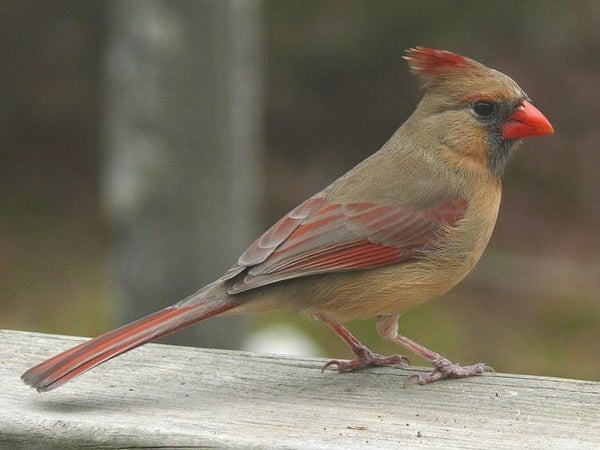

Many people assume that male songbirds are the ones doing the crooning. But more than 660 species of songbirds are known in which the females sing as well. And there are still 3,500 species of songbird in which the female singing status is unknown. Which implies that there could be plenty more female singers to be found.
“We often talk to people, both people who are scientists and ornithologists but also people who are birders and citizen scientists, who say, ‘Yeah you know, I have this story where a female was clearly singing.’”
On supporting science journalism
If you're enjoying this article, consider supporting our award-winning journalism by subscribing. By purchasing a subscription you are helping to ensure the future of impactful stories about the discoveries and ideas shaping our world today.
Biologist Lauryn Benedict, of the University of Northern Colorado.
These field reports inspired Benedict and Cornell behavioral ecologist Karan Odom to start the Female Bird Song Project with a group of colleagues in 2017. The goal is to get professional researchers and citizen scientists alike to submit recordings and field notes of birdsong from both males and females.
LB: “And we're hoping to really give them ways to report that and document it so that we can aggregate that information in useful ways.”
On the project’s website, FemaleBirdSong.org, you can hear various birds of both sexes—and complex duets sung by pairs of songbirds, like these Black Bellied Wrens.
Now Benedict and Odom are asking scientists to consider the existence of female birdsong in their research, even when it’s not their primary focus—for example, from studying avian neurobiology to collecting population data for bird conservation. They wrote up their goals in the journal The Auk: Ornithological Advances. [Karan J. Odom and Lauryn Benedict, A call to document female bird songs: Applications for diverse fields]
Studying female birdsong is no simple task. Here’s Karan Odom: “So the biggest thing is to see the bird, which is number one not trivial. And number two, in the past since birdsong has been thought of as a male trait, it might not be that researchers were always verifying the sex of the bird by finding it and looking at it. So we're asking people to please be aware that females sing and to actually get a look at the bird that you're recording.”
These researchers hope that more awareness of female song will lead to better-informed studies that can tell us when and why female birds are singing. And perhaps reveal aspects of avian life that no one has yet considered.
—Sarah Witman
[The above text is a transcript of this podcast.]
[Bird songs courtesy of http://femalebirdsong.org]
