
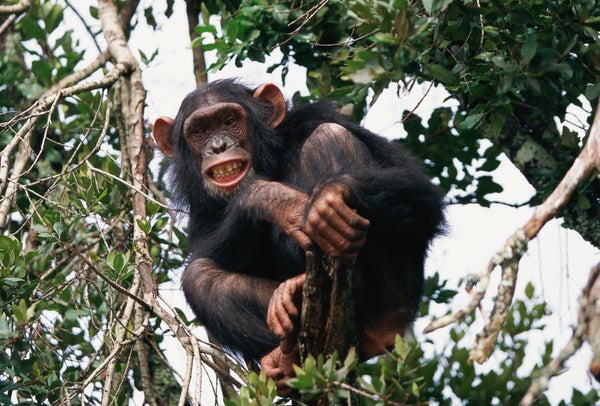

That means danger—to a chimpanzee. Chimps use this call, known as an "alert hoo," to warn each other about a potential threat, like a dangerous snake on the forest floor. And researchers have now used recordings of that call to get inside the chimpanzee mind.
"There is more studies showing that various animals seem to be able to take another's perspective into account to a certain extent. They seem to be able to understand what another sees or doesn't see for example."
On supporting science journalism
If you're enjoying this article, consider supporting our award-winning journalism by subscribing. By purchasing a subscription you are helping to ensure the future of impactful stories about the discoveries and ideas shaping our world today.
Catherine Crockford, a primatologist at the Max Planck Institute for Evolutionary Anthropology in Germany.
Crockford and her team traveled to Uganda's Budongo Forest to study the ability of chimps to modify their calls based upon the knowledge of others.
They hid a fake snake on the ground and then used a loudspeaker to broadcast chimp calls. In some cases, the speaker played that alarm call, the "alert hoo,"
suggesting to listeners that a nearby chimp was aware of the snake.
But in other cases, the speaker played a different kind of call called a rest hoo,
[rest hoo recording].
This non-alarm told listeners that the chimp they were hearing was not aware of any snake danger.
And when the chimps who had heard the rest hoo came across the fake snake, they gave ample warnings, using both their alarm calls and body language. But when chimps heard the alarm call before encountering the fake snake, they produced fewer alert hoos—apparently satisfied that their comrades were aware of the threat. The study is in the journal Science Advances. [Catherine Crockford, Roman M. Wittig, & Klaus Zuberbühler, Vocalizing in chimpanzees in influenced by social-cognitive processes]
"So we were able to tease those things apart and show that the main motivation for their calling didn't really fit with their own emotional state or their own habituation level to the snake, so it really seemed that they were taking into account the others' perspective."
Seems that, like humans, chimps and perhaps other primates are able to adjust their communications based on what they think their intended recipients think. Which is clearly a useful ability for intelligent beings that have complex social lives.
—Jason G. Goldman
[The above text is a transcript of this podcast.]
